Commemorating the Fallen of WW1

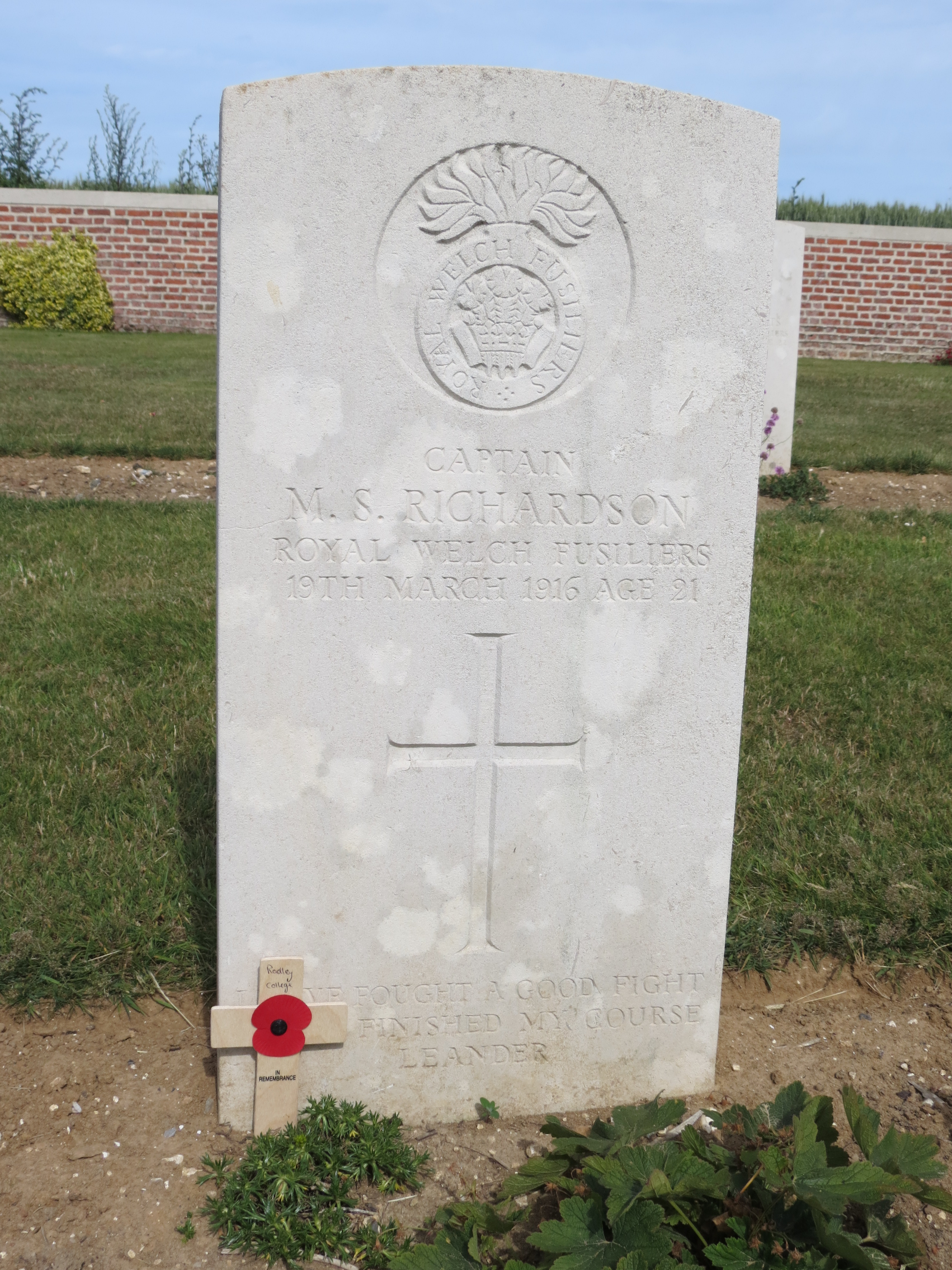
The grave of Mervyn Richardson at Point 110 Cemetery.  Photographed for 'Marching in Memory' for Combat Stress, July 2015

The grave of Mervyn Richardson at Point 110 Cemetery. Photographed for ‘Marching in Memory’ for Combat Stress, July 2015

Today we remember …

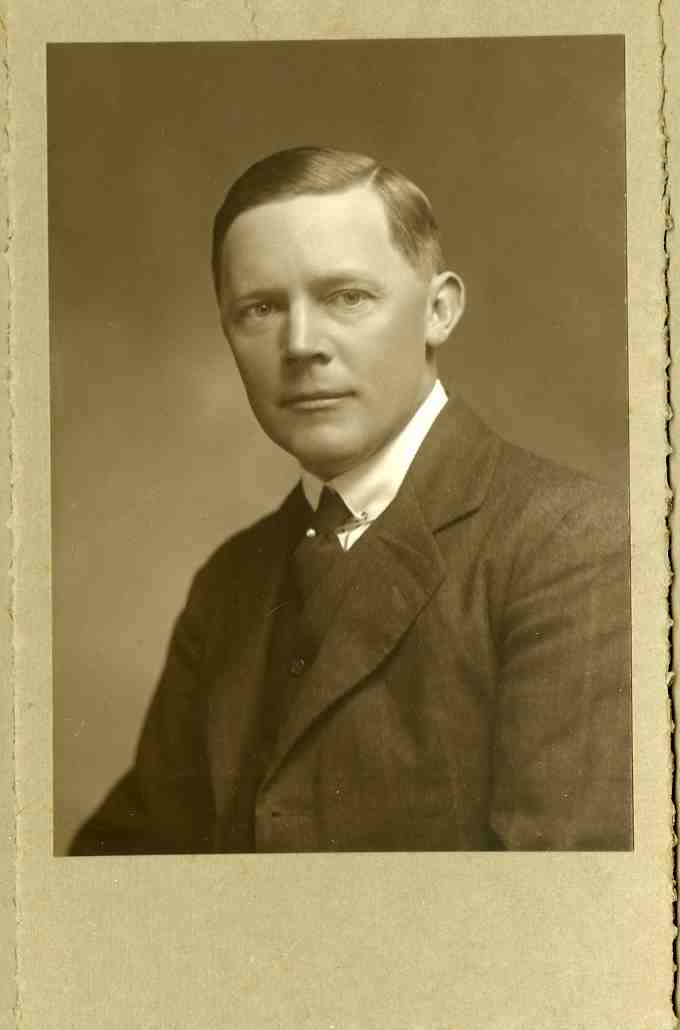
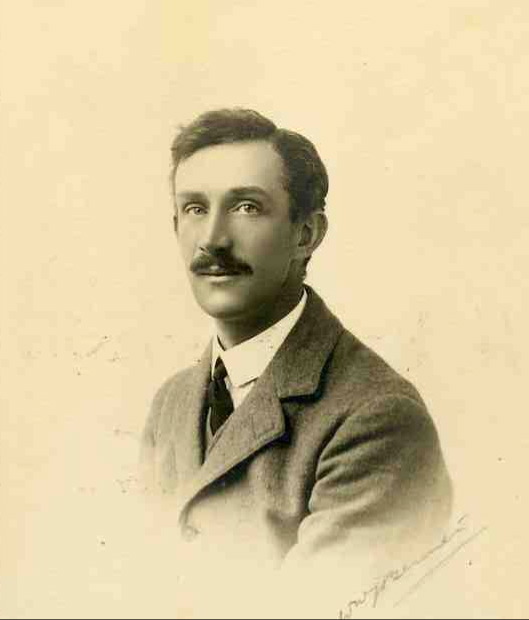
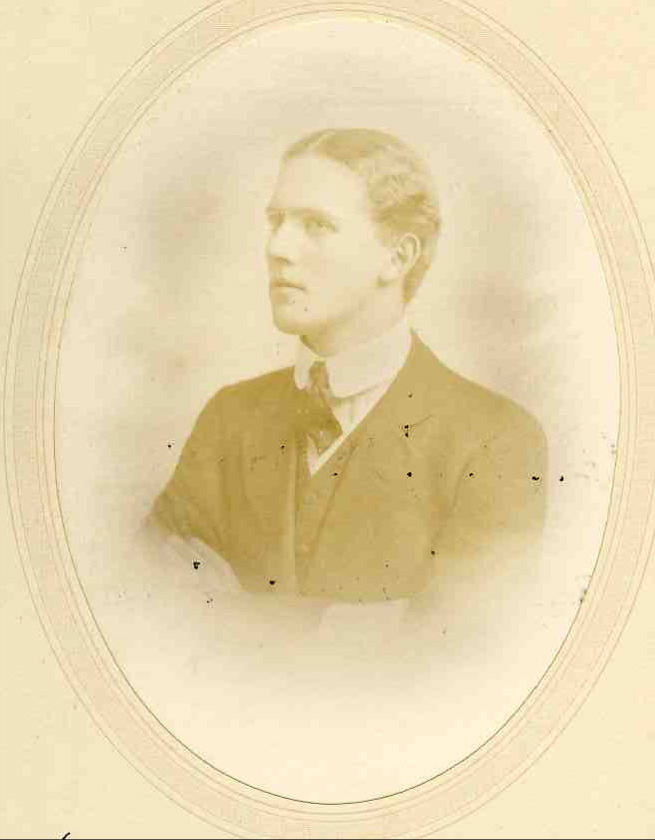
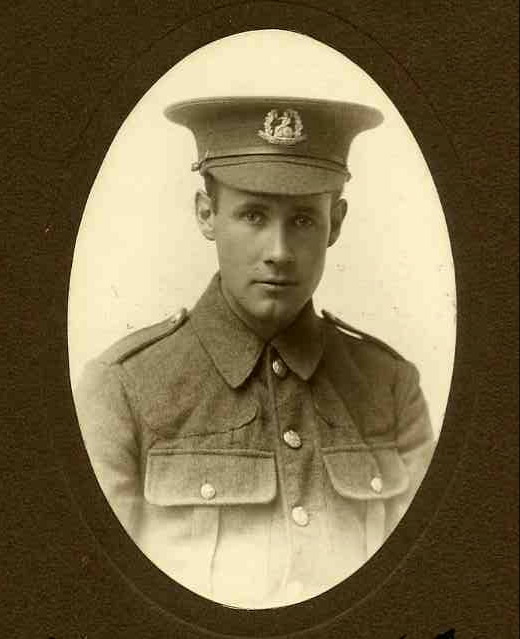
19th March 1916.  Mervyn Richardson, D Social, 1908.  Capt, 1st Bn, Royal Welsh Fusiliers.  Died of wounds received in an unknown engagement.‘Tracker’ Richardson was one of the young officers mentioned in Siegfried Sassoon’s diary, which became his fictional Memoirs of a fox-hunting man. At Radley he was Captain of the Boats, and rowed twice at Henley in the Ladies’ Plate, rowing No. 6 in the winning heat v. University College, Oxford, in 1912. He was a member of the Leander Club. After leaving school, he attended Sandhurst, then went straight out to the Western Front in 1915. He was Mentioned in Despatches.  A letter from the Regimental Chaplain to his parents describes the scene of his funeral:CHAPLAIN’S LETTER, March 22 (Wed.).

DEAR SIR,-You might care I think to know the details of your son’s burial and last resting place from the Chaplain of the Regiment?… Your son was the most gallant and best loved of a gallant band of young officers… I have been with the battalion a year, and through more than one action, yet I do not remember so solemn a funeral or such real quiet grief. It took place on Tuesday night at 9.45. The little burial ground lies in a slight hollow only 100 yards behind the front lines. The nearest village is Reanite, near Albert, but from there it is a walk of two miles over rolling chalk downs to the line. The little plot is reverently tended, and a cross already in position on the grave. At the end of the war you will find no difficulty in finding it and tending it as you like.

As we left the dug-outs for the cemetery, two canisters burst quite near with a deafening roar. There in the darkness I took the service. All the officers were present and many men. The moon came out in the middle, and shone on the grey steel helmets of the group, and made the colours of the Union Jack that lay on the body gleam. The service ended, to the roar of another German canister, more suitable perhaps to the occasion than any organ.

Eric Milner-White

Aged 22

Mervyn Richardson, Captain, 1st Bn, Royal Welsh Fusiliers.  Died of wounds 19 March 1916

Mervyn Richardson, Captain, 1st Bn, Royal Welsh Fusiliers. Died of wounds 19 March 1916

Commemorating the Fallen of WW1

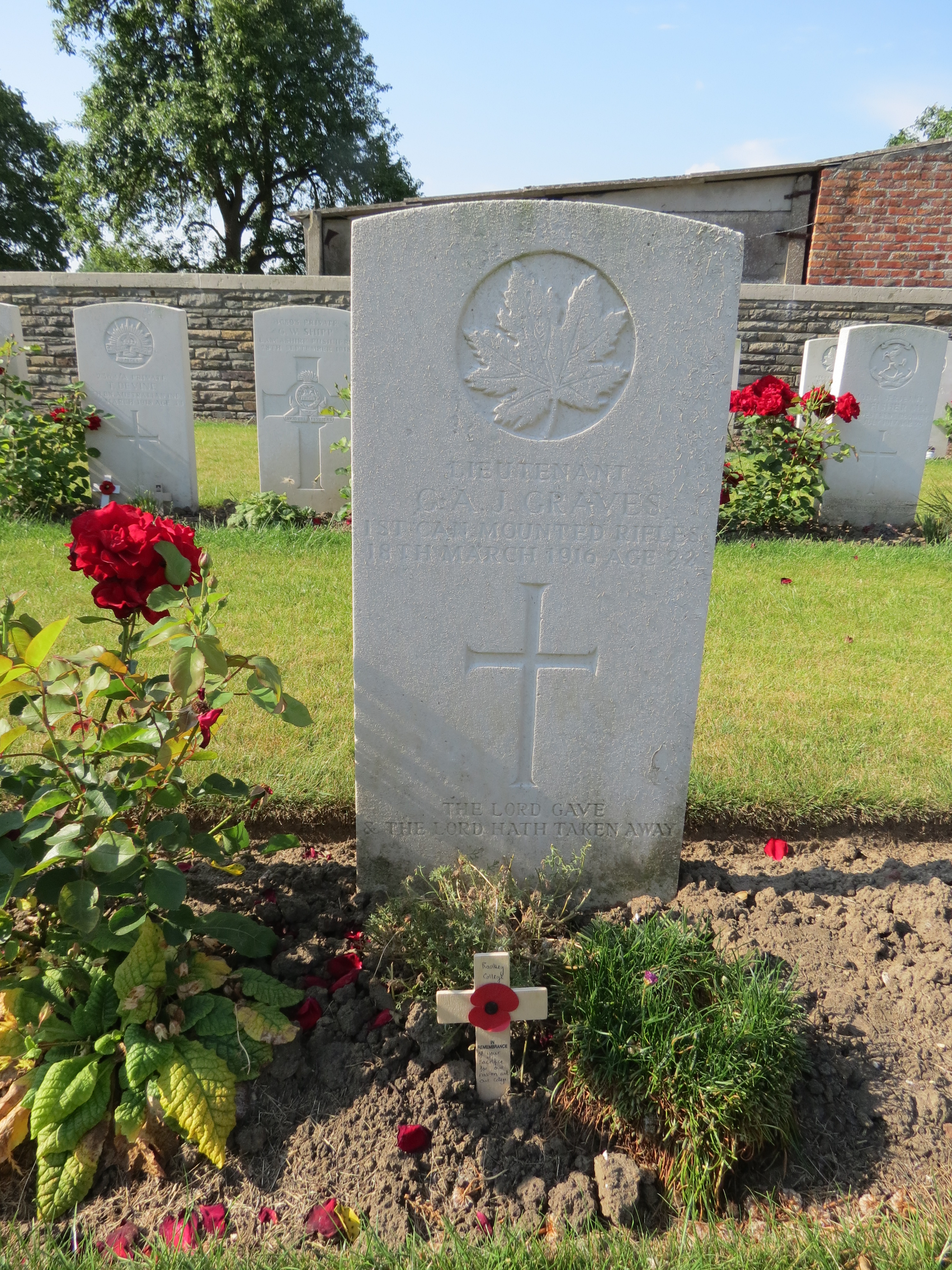
The grave of Geoffrey Graves at Menin Rd South Cemetery.  Photographed for 'Marching in Memory' for Combat Stress, July 2015

The grave of Geoffrey Graves at Menin Rd South Cemetery. Photographed for ‘Marching in Memory’ for Combat Stress, July 2015

Today we remember …

18th March 1916.  Geoffrey Graves, E Social, 1907.  Lt, 1st Canadian Mounted Rifles, (Saskatchewan Regiment)  Canadian Expeditionary ForceKilled in action in an unknown engagement at Hooge.  Geoffrey Graves has no obituary in The Radleian.  He left Radley in 1910 after just three years.  The Commonwealth War Graves Commission lists him as ‘An intelligence officer’. We have no further information.  Aged 22

Geoffrey Graves, Lt, 1st Canadian Mounted Rifles.  kia at Hooge 18 March 1916

Geoffrey Graves, Lt, 1st Canadian Mounted Rifles. kia at Hooge 18 March 1916

Commemorating the Fallen of WW1

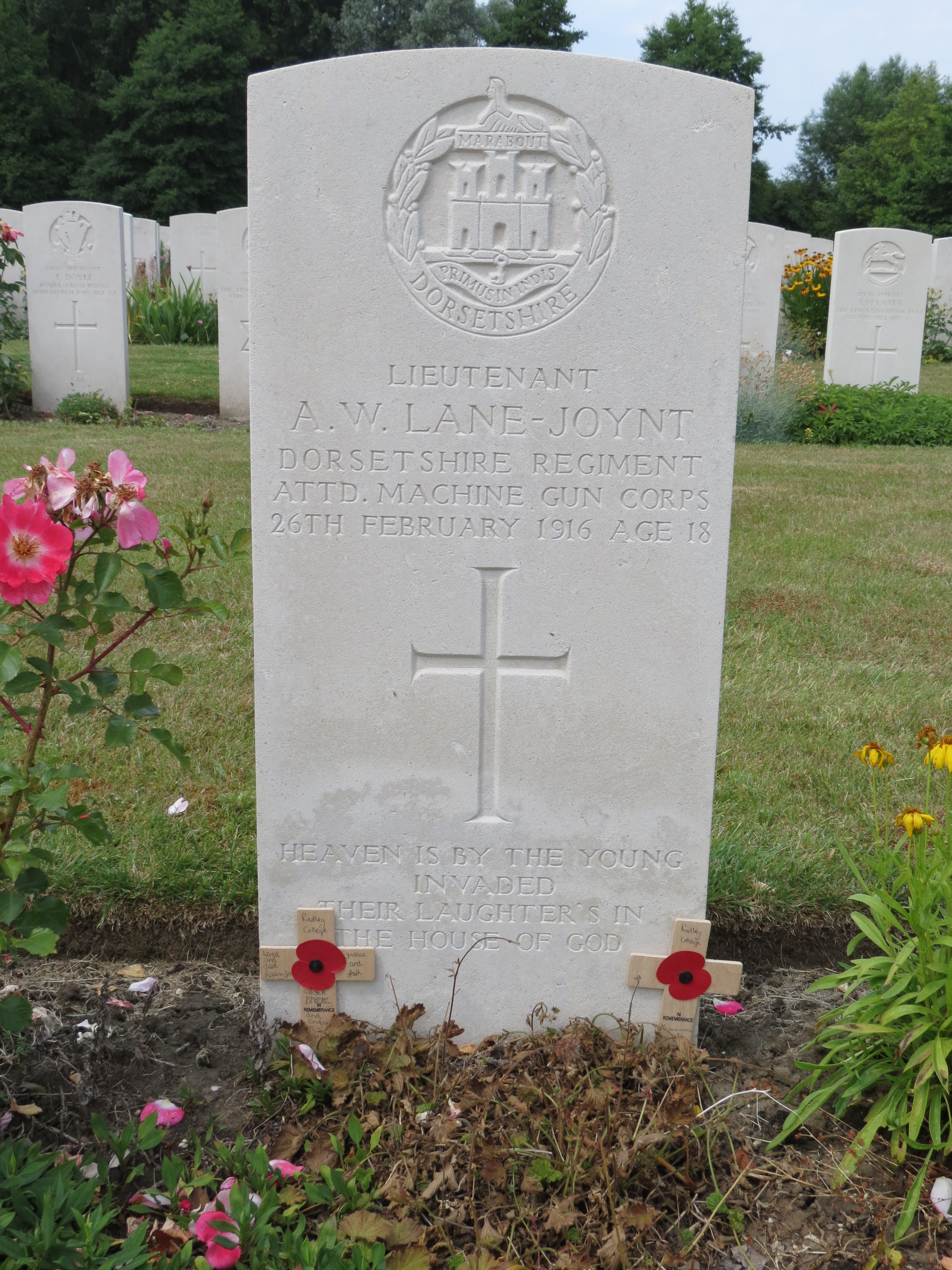
The grave of Albert Lane-Joynt, Guards Cemetery.  Photographed for 'Marching in Memory' for Combat Stress, July 2015

The grave of Albert Lane-Joynt, Guards Cemetery. Photographed for ‘Marching in Memory’ for Combat Stress, July 2015

Today we remember …

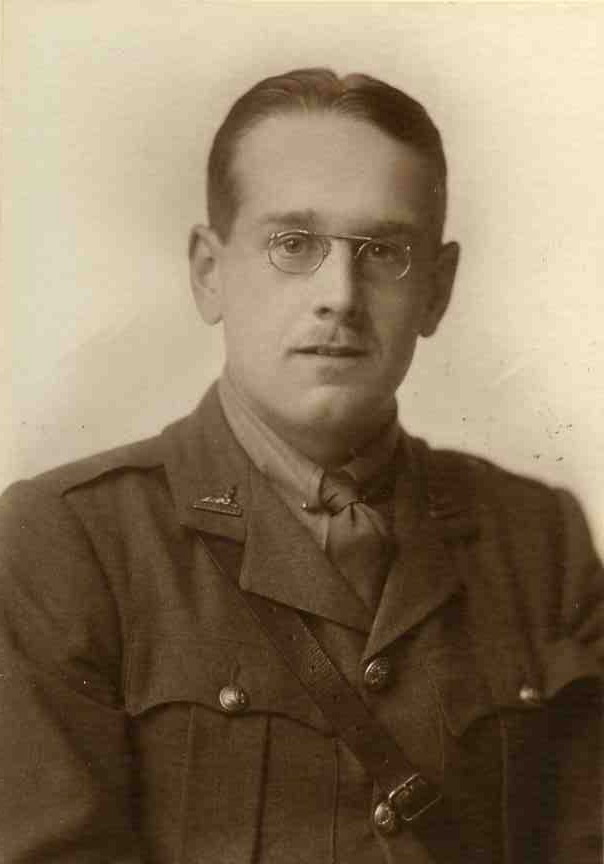
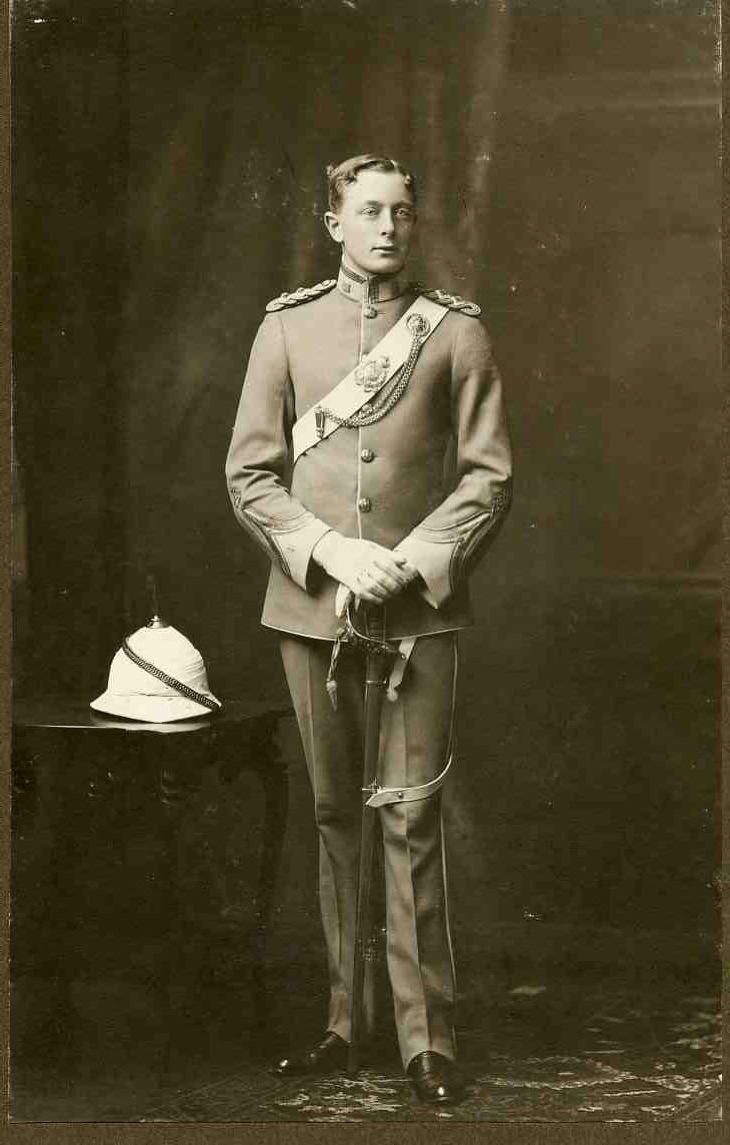
26th February 1916.  Albert Lane-Joynt, B Social 1909.  Lt, Machine Gun Corps.  Killed by a sniper in France.  Albert Lane-Joynt played for the Cricket XI in 1913, and joined Surrey CC after leaving school. He is commemorated on the War Memorial at Kennington Oval.  He was a cricket aficionado who wrote magazine articles, and immediately on leaving school produced his first issue of the Public Schools Cricket Year Book.


A history of Radley cricket, by AW Lane-Joynt, 1914: … ‘the three best cricket Xl’s turned out by Radley were those of 1867, 1888, and 1913. … The 1913 side had the estimable advantage of a really good captain in O. A. Reid. He was a fine hard-hitting consistent bat and scored 101 (not out) in 80 minutes against Bradfield. His wicket-keeping was better than ever and when he bowled he was certainly the best bowler on the side. Both he and R. C. Keller had averages of 40; with the latter he bore the brunt of the season’s work. Keller is a really fine player with a beautiful cut, and should be heard of in the future.  Reid was asked to play in the Public Schools Trial match at Lords… and was eventually chosen as first change bowler for the Public Schools XI.  Expert opinion unanimously placed our team high among the school sides of 1913, and there could be no more fitting place to end this brief resume of Radley Cricket.’

[OA Reid won the VC in Mesopotamia in 1917. He died at Johannesburg in 1920. RC Keller served in France 1915-1917, was seconded to the Royal Flying Corps, was shot down and ended WW1 as a POW. ]


Aged 20

Lt Albert Lane-Joynt, Machine Gun Corps.  kia 26 February 1916

Lt Albert Lane-Joynt, Machine Gun Corps. kia 26 February 1916

Commemorating the Fallen of WW1

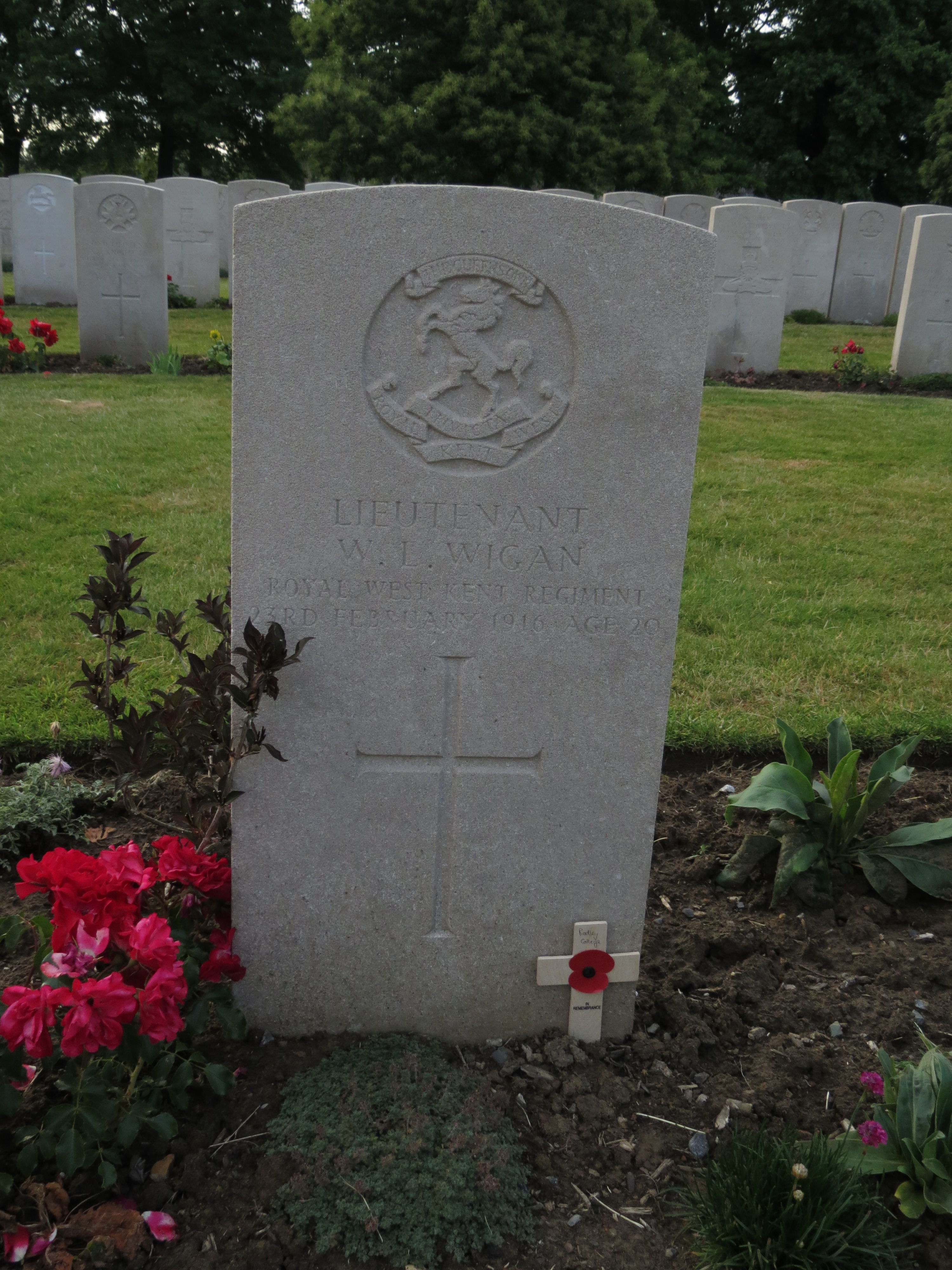
The grave of William Wigan at Lijssenthoek.  Photographed for 'Marching in Memory' for Combat Stress, July 2015

The grave of William Wigan at Lijssenthoek. Photographed for ‘Marching in Memory’ for Combat Stress, July 2015

Today we remember …

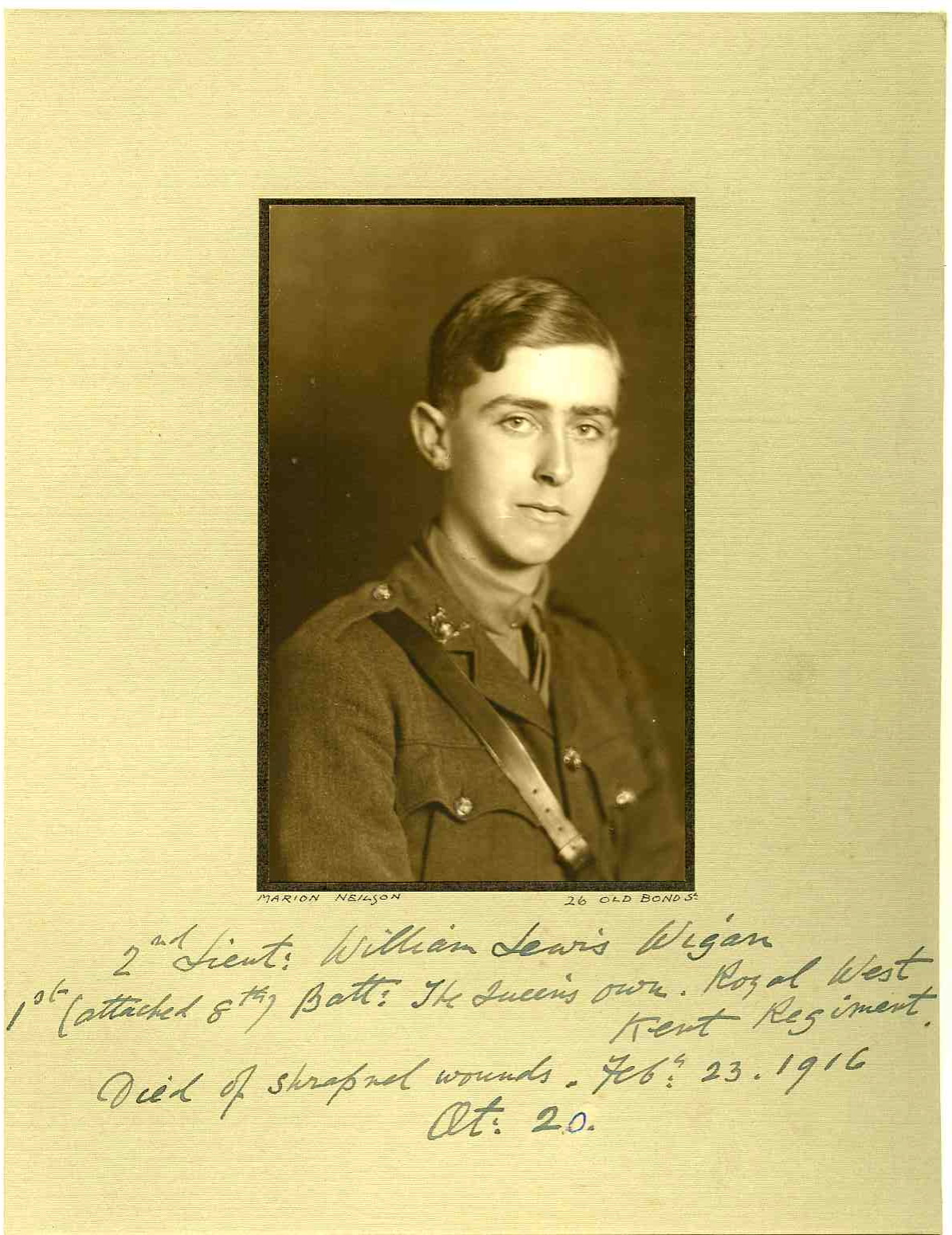
23rd February 1916.  William Wigan, E Social 1909.  Lt, Royal West Kent Regt.  Died of shrapnel wounds near Ypres.   He went to Sandhurst in September 1914. 

‘ …. He was in a dug-out two and a half miles behind the firing line, with his Captain and two other subs., when a shell dropped in Battalion Commander’s Headquarters some six yards behind them. The Captain who was nearest the door went out to see what had happened and the other three must have started to follow him when another shell dropped right in the doorway wounding all three. The Captain writes: ‘I went to the dug-out to see what I could do, but your son, who looked very pale. though quite calm, waved me away, saying: “Get away, you are the only one left in the Company.” I then sent for stretcher-bearers and doctor: your son then asked for a cigarette which I gave him and lit it for him. The stretcher-bearers, four in number, then went to him, but he said, ‘Look to the others who are worse first, I shall be all right, I have got one leg broken, and am hit through the other.’ …. As I walked with him he said, ‘ Don’t look so worried about me, I shall be all right; shall see you at home.’  I then had to leave him to take my men to the trenches.

As I said good-bye to him he blew me a kiss and wished me good luck… I cannot tell you how much we valued and loved him, what a good hard-working officer he was… He was beloved of all the men of the Company, who realised his efforts for them. and what a good hard-working officer he was. . . always cheery, courageous, and energetic. . . He was taken suddenly worse on the morning of the 23rd, became unconscious about 2 pm and died about 4 pm.’


Aged 20

Lt William Wigan, Royal West Kent Regt.  Died of wounds 23 February 1916

Lt William Wigan, Royal West Kent Regt. Died of wounds 23 February 1916

Commemorating the Fallen of WW1

Today we remember …

12th February 1916.  Gordon Rennie, G Social 1902.  Captain, 6th South African Infantry, South African Forces. Killed in action at Salaita Hill, British East Africa (now Kenya).

Gordon Rennie was born in Durban, Natal, SA. After school he worked as a shipping agent between London and Durban. He married Marion Steele in 1913.


‘Rennie took two trenches by assault, but came under such heavy cross maxim fire that he could not move. We stuck it for three hours, when the order came to retire. Rennie was mortally wounded and unconscious, and Burke took over “A” Company. All our wounded and killed, as far as possible, had to be got back. Poor Rennie and others had to be carried over three miles. The gunners on our side were wonderfully good, but the enemy were so numerous we could not check them, and all the time we were under a murderous fire. We expected an attack which mercifully did not come. The officers placed poor Gordon Rennie in his grave, and the Durban Light Infantry fellows lay beside him. Our chaplain was wounded earlier in the day, and Col. Molyneux said the burial service just at dusk. We could fire no volley, but the boom of the guns was his requiem. He is a heavy loss. All through he had done excellently, and no one could have done more than he. There is hardly a dry eye in his Company.’

Aged 28

Captain Gordon Rennie, 6th South African Infrantry.  kia 12 February 1916 in British East Africa (Kenya)

Captain Gordon Rennie, 6th South African Infrantry. kia 12 February 1916 in British East Africa (Kenya)

Commemorating the Fallen of WW1

Today we remember …

18th December 1915.  John Douglas, E Social 1891.  Major, 10th Bn, Yorkshire Regt.  Died of wounds received in an unknown engagement in France.


After leaving school, he went to Merton College, Oxford and then qualified as a barrister at Gray’s Inn. He spent some time in South Africa, and then went to Shanghai: ‘He was very popular in Shanghai, where he was known as “one of the best magistrates the Settlement ever had.” Latterly he had been in private practice as an advocate in the Supreme Court of China and Korea.’  He left Shanghai with a contingent of volunteers in 1914.


Aged 39

John Douglas, Major, 10th Bn, Yorkshire Regt.  Died of wounds 18 December 1915

John Douglas, Major, 10th Bn, Yorkshire Regt. Died of wounds 18 December 1915

Commemorating the Fallen of WW1

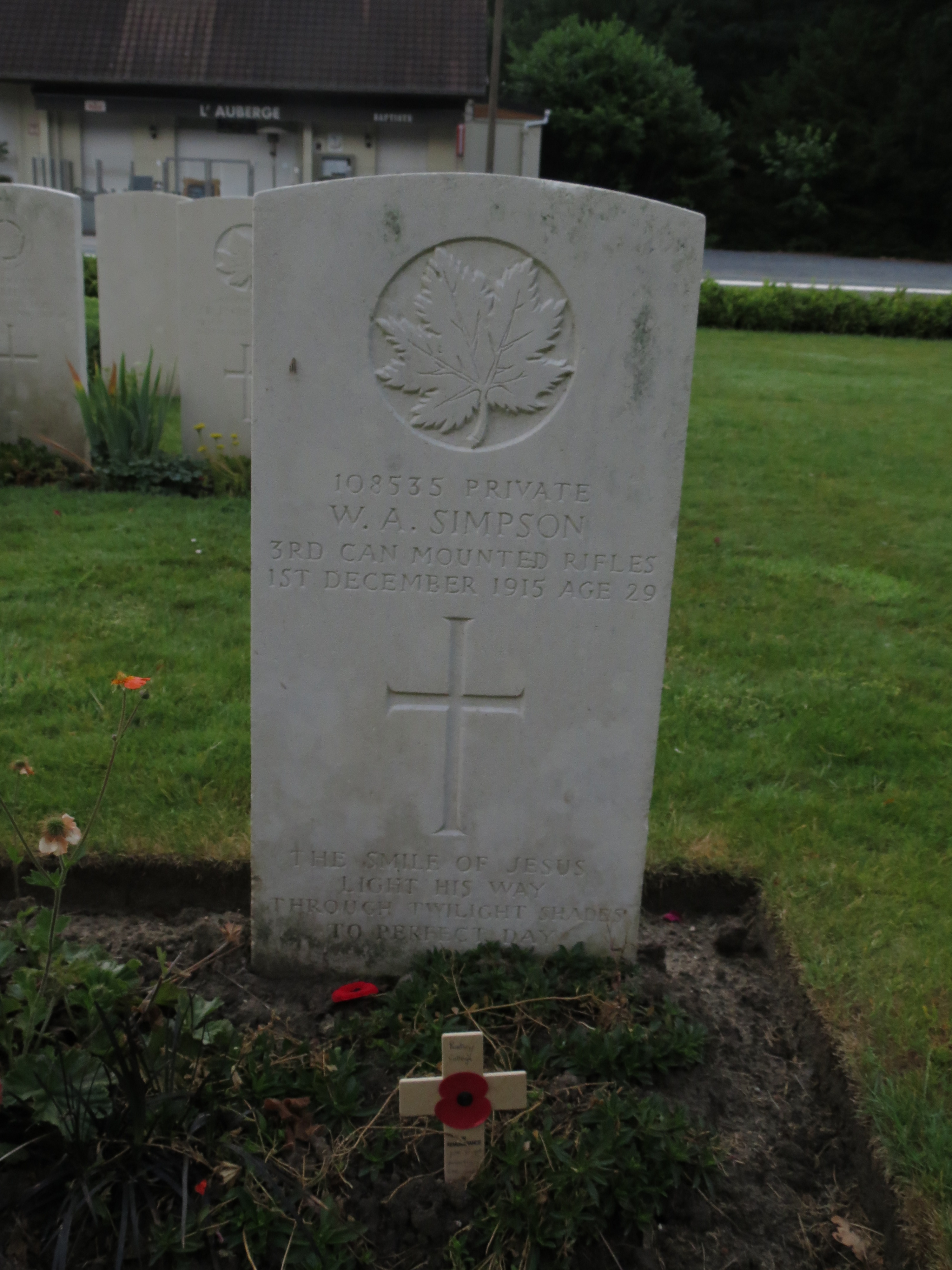
The grave of Walter Simpson at Berks Cemetery.  Photographed for 'Marching in Memory' for Combat Stress, July 2015

The grave of Walter Simpson at Berks Cemetery. Photographed for ‘Marching in Memory’ for Combat Stress, July 2015

Today we remember …

1st December 1915.  Walter Simpson, D Social 1900.  Trooper, 3rd Canadian Mounted Rifles, Canadian Expeditionary Force.  Killed in action in an unknown engagement in Flanders.


He was a good oarsman who rowed for Cambridge University Trial VIII in 1906, and won the Ladies Plate at Henley in 1907.


Aged 29


Walter Simpson, Trooper, 3rd Canadian Mounted Rifles, Canadian Expeditionary Force.  kia 1 December 1915

Walter Simpson, Trooper, 3rd Canadian Mounted Rifles, Canadian Expeditionary Force. kia 1 December 1915

Commemorating the Fallen of WW1

Today we remember …

17th November 1915.  Henry Napier, A Social 1890.  Major, 11th Bn, Sherwood Foresters.  Wounded in the Battle of Loos. Drowned in the sinking of the hospital ship HMS Anglia.


HMS Anglia hit a German mine just outside Dover. The majority of the wounded and nursing staff were lost. The steamer Lusitania, which came to her aid, was also destroyed by a mine after launching life boats to help save the personnel on the Anglia.


Henry Napier had retired from active service in 1909. He was recalled to the Sherwood Foresters in 1914.  Aged 39

Henry Napier, Major, 11th Bn, Sherwood Foresters.  Wounded and drowned 17 November 1915

Henry Napier, Major, 11th Bn, Sherwood Foresters. Wounded and drowned 17 November 1915

Commemorating the Fallen of WW1

Today we remember …

31st October 1915.  Drostan Russell, D Social 1904.  Rifleman, Northern Rhodesian Rifles, South African Forces.  Died of blackwater fever in Zambia, and listed as ‘died on active service’ 

Aged 24

Drostan Russell, Rifleman, Northern Rhodesian Rifles, South African Forces.  Died on active service 31 October 1915

Drostan Russell, Rifleman, Northern Rhodesian Rifles, South African Forces. Died on active service 31 October 1915

Commemorating the Fallen of WW1

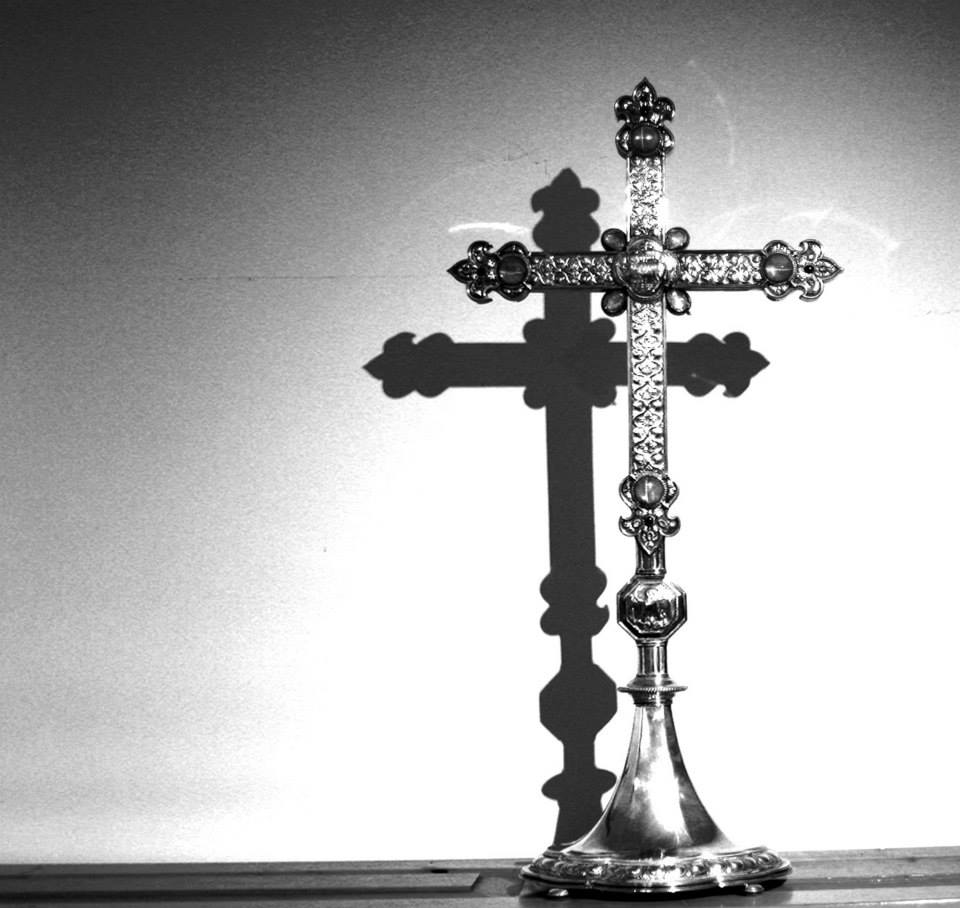
Silver, moonstone and amethyst cross designed for Radley College by George Sedding, 1910

Silver, moonstone and amethyst cross designed for Radley College by George Sedding, 1910

Today we remember …


23 October 1915.  George Sedding, A Social 1896.  Lance-Corporal, 7th Bn, Norfolk Regt.  Died of wounds received in the Battle of Loos.


He was a silversmith, a follower of the Arts and Crafts Movement. An example of his jewellery survives in the Fitzwilliam Museum, Cambridge. In 1910, he designed and gave the cross and candlesticks which are still on the communion table in Radley College chapel. He was a committed Christian. One of his last letters home shows both his deep love of God and of the jewel bright colours of nature, written in the horror of Ploegsteert Wood:

I wrote a little prayer last night. . . . There are such a lot of stray bullets about that you want something of the sort to repeat and think of on occasions. ‘Under the shadow of Thy wings, 0 Christ, shall I rest in peace. For as in love they enfold me, I will look up and behold their shining glory, arched in a vault of dusky gold, gleaming with rainbow hues. Gold for sovereignty and power, with all the wondrous graces, charity and love, that colour Thy divinity. So shall I rest in peace, and at my death, 0 Light of Lights, give me grace to come without the shadows, and to look upon Thy most holy face.‘’


Aged 33

George Sedding, Lance-Corporal, 7th Bn, Norfolk Regt.  Died of wounds 23 October 1915

George Sedding, Lance-Corporal, 7th Bn, Norfolk Regt. Died of wounds 23 October 1915