The grave of Charles Ellerton at Ecoivres Cemetery. Photographed for ‘Marching in Memory’ for Combat Stress, July 2015
Today we remember …

The grave of Charles Ellerton at Ecoivres Cemetery. Photographed for ‘Marching in Memory’ for Combat Stress, July 2015
Today we remember …

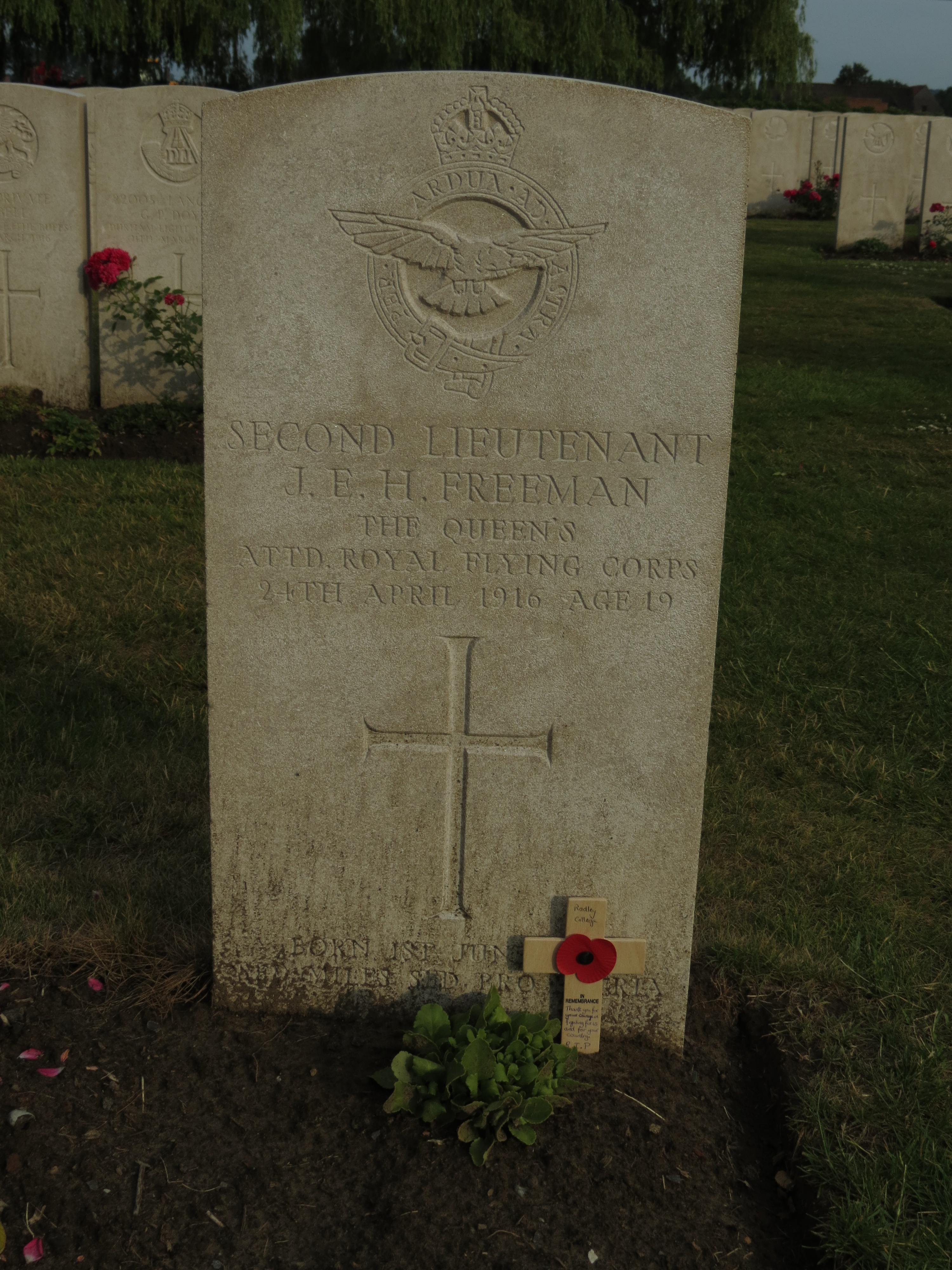
The grave of James Freeman at Lijssenthoek. Photographed for ‘Marching in Memory’ for Combat Stress, July 2015
Today we remember …
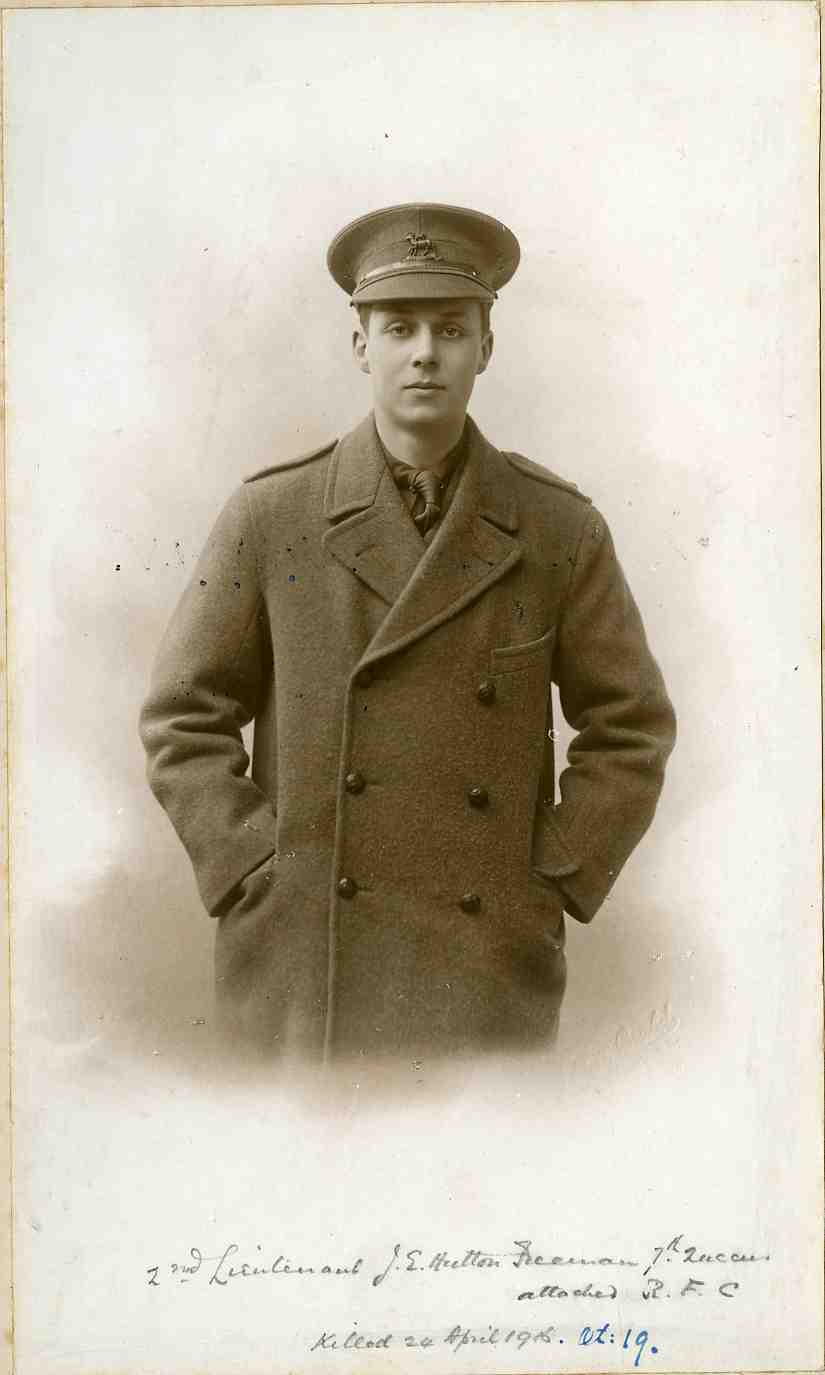
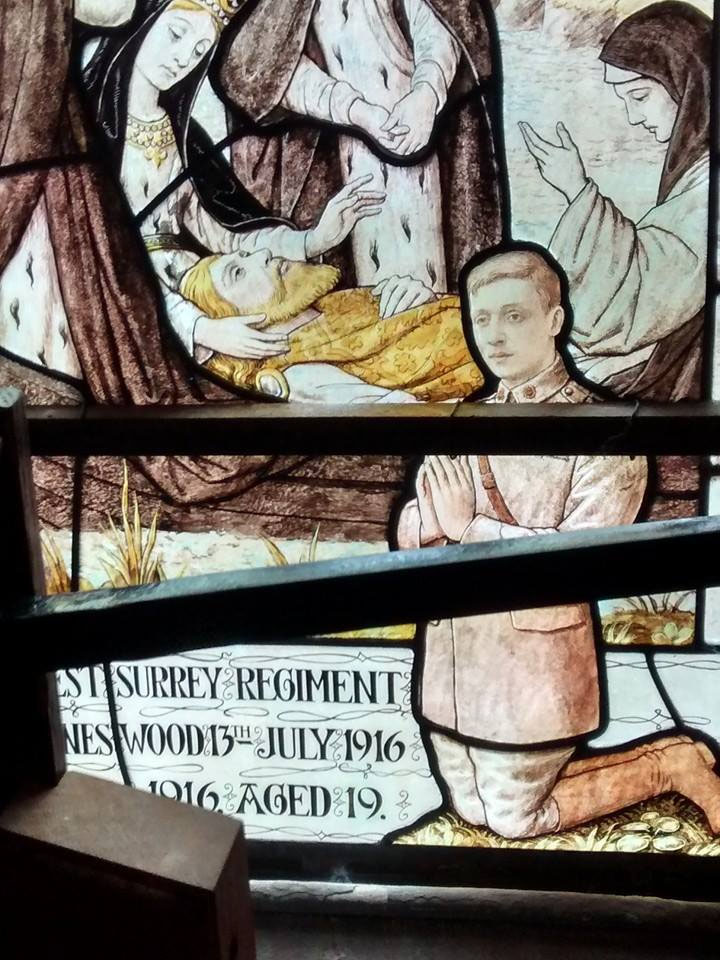
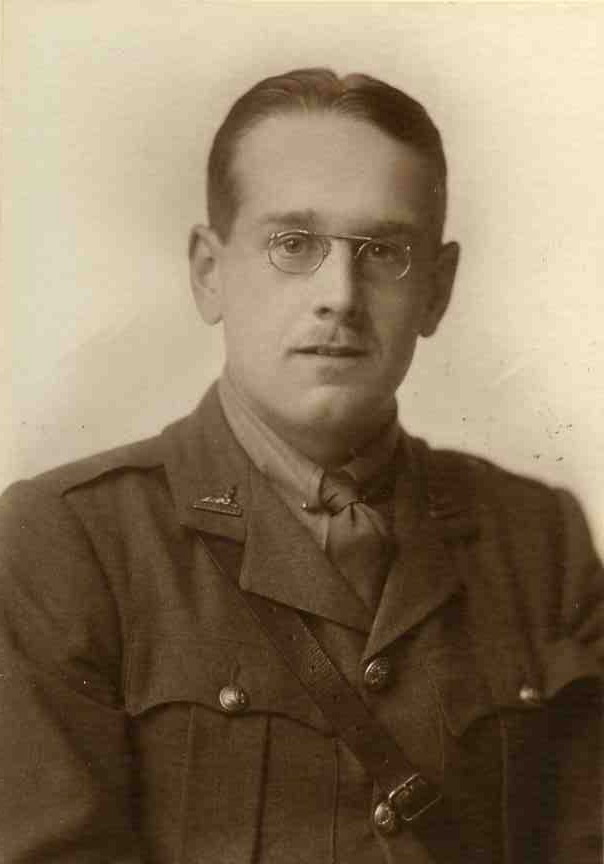
| 24th April 1916. James Freeman, C Social, 1910. 2nd Lt, 29th Sqn, Royal Flying Corps Killed in a flying accident over Flanders. He survived a serious crash shortly before in which his plane broke up in mid-air. The photo opposite was taken soon after: ‘I have before me, as I write, a photograph taken just after by one of his greatest friends. There he stands, with the pleasant trustful smile on his face that many of us knew so well.’ from his obituary in The Radleian. At school, James Freeman rowed for the 1st VIII, was a keen member of the Corps, and nowadays would be most often found in the Design Centre: ‘devoted to the carpenter’s shop. Thrust away in a corner by the stables one may still see – causam lacrymis! – that wonderful motor car which he constructed with such delight…’ His closest friend was Gilbert Whittet, also of C Social and a member of the VIII, who was to die on the Somme just three months later. Gilbert Whittet’s parents generously included James jointly with Gilbert in a stained glass window put up in Chapel in 1917. The window depicts four figures, St Michael, St George, King Alfred, and King Arthur, and portraits of the two young men.This is a window of tears. … But it is also a Window of Pride – just Pride – Radley is proud to-day that two young lives have shown the stuff which Radley can produce – proud that two boys have shown what a clean tender true friendship can be. They walked in this House of God as friends and in that nearer Presence they are friends still … Remember that Military Service with all its glamour is only on the same footing as your service here. The one great principle is duty. They had to be trained and equipped, to go through drudgery, self-denial, and learning and labour; they did their duty and won their reward… Like Michael fight for God against the powers of evil. Like St George learn habits of courtesy towards your fellow men. Like King Arthur and his Knights practice perfect chivalry to all women. Like King Alfred learn to be a ruler for good – of yourselves first, and then of Society round you. … Bishop Hook, speaking at the unveiling of the memorial window to Freeman and Whittet in 1917. Aged 19 |

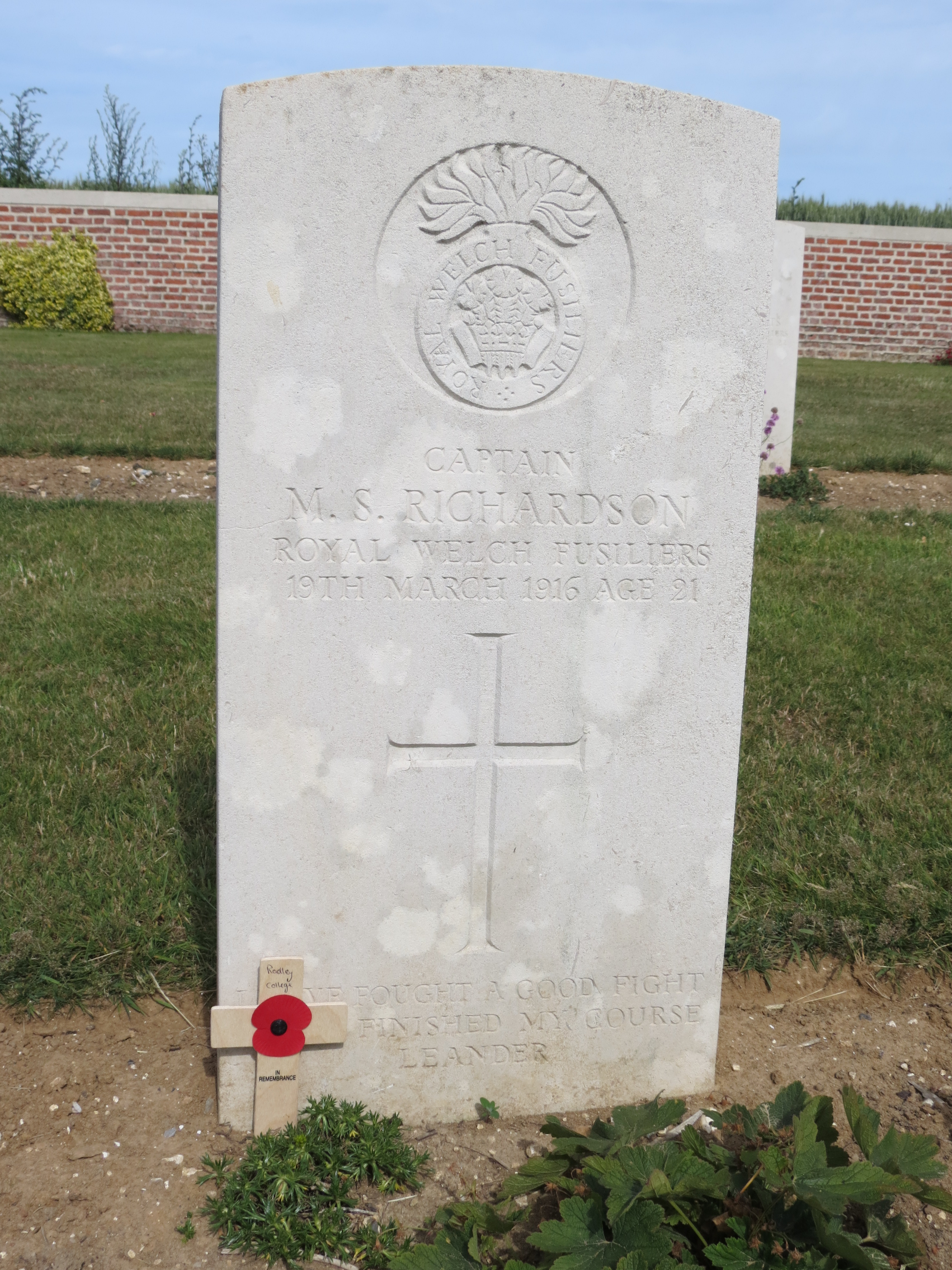
The grave of Mervyn Richardson at Point 110 Cemetery. Photographed for ‘Marching in Memory’ for Combat Stress, July 2015
| 19th March 1916. Mervyn Richardson, D Social, 1908. Capt, 1st Bn, Royal Welsh Fusiliers. Died of wounds received in an unknown engagement.‘Tracker’ Richardson was one of the young officers mentioned in Siegfried Sassoon’s diary, which became his fictional Memoirs of a fox-hunting man. At Radley he was Captain of the Boats, and rowed twice at Henley in the Ladies’ Plate, rowing No. 6 in the winning heat v. University College, Oxford, in 1912. He was a member of the Leander Club. After leaving school, he attended Sandhurst, then went straight out to the Western Front in 1915. He was Mentioned in Despatches. A letter from the Regimental Chaplain to his parents describes the scene of his funeral:CHAPLAIN’S LETTER, March 22 (Wed.).
DEAR SIR,-You might care I think to know the details of your son’s burial and last resting place from the Chaplain of the Regiment?… Your son was the most gallant and best loved of a gallant band of young officers… I have been with the battalion a year, and through more than one action, yet I do not remember so solemn a funeral or such real quiet grief. It took place on Tuesday night at 9.45. The little burial ground lies in a slight hollow only 100 yards behind the front lines. The nearest village is Reanite, near Albert, but from there it is a walk of two miles over rolling chalk downs to the line. The little plot is reverently tended, and a cross already in position on the grave. At the end of the war you will find no difficulty in finding it and tending it as you like. As we left the dug-outs for the cemetery, two canisters burst quite near with a deafening roar. There in the darkness I took the service. All the officers were present and many men. The moon came out in the middle, and shone on the grey steel helmets of the group, and made the colours of the Union Jack that lay on the body gleam. The service ended, to the roar of another German canister, more suitable perhaps to the occasion than any organ. Eric Milner-White Aged 22 |

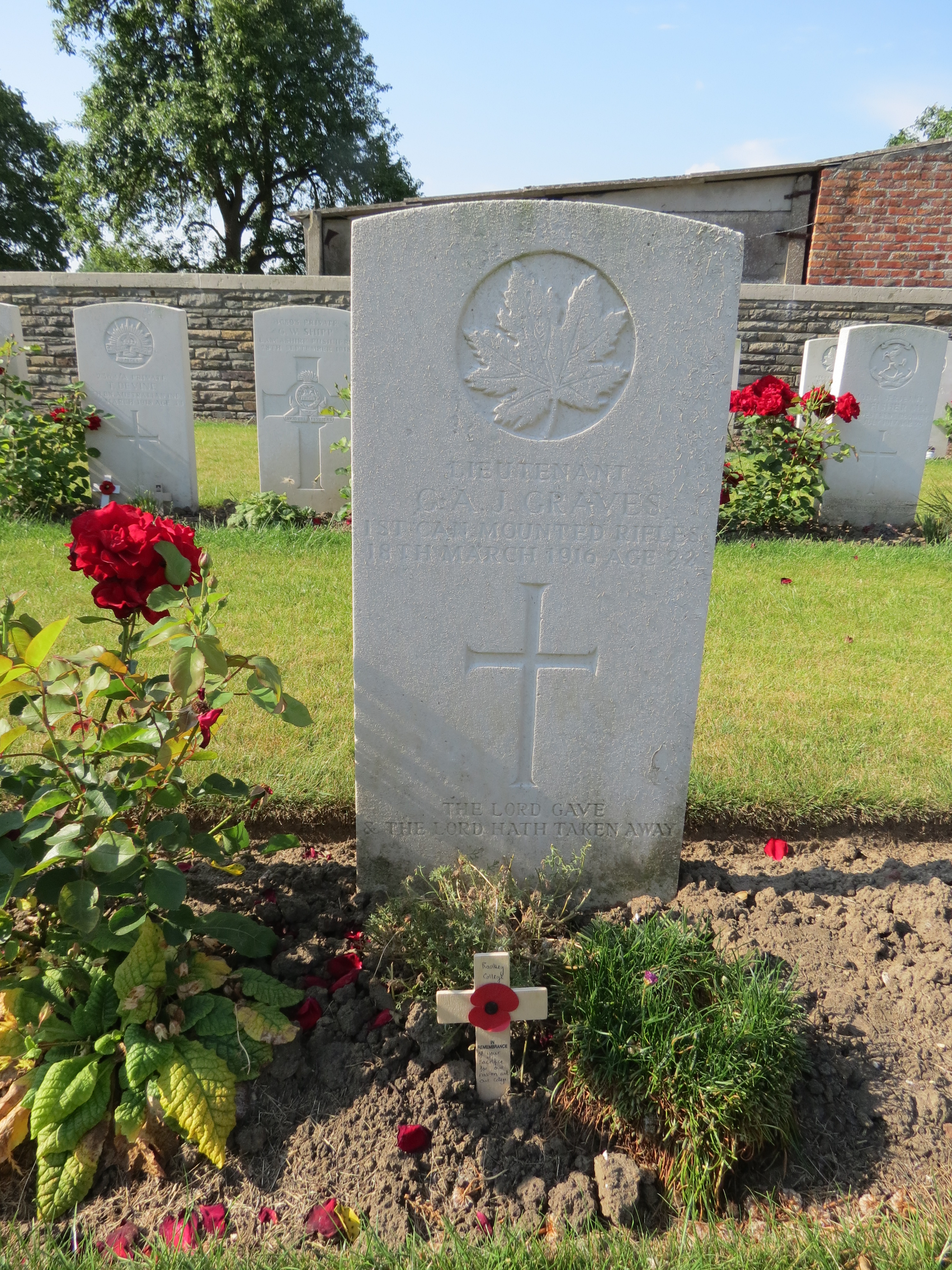
The grave of Geoffrey Graves at Menin Rd South Cemetery. Photographed for ‘Marching in Memory’ for Combat Stress, July 2015
| 18th March 1916. Geoffrey Graves, E Social, 1907. Lt, 1st Canadian Mounted Rifles, (Saskatchewan Regiment) Canadian Expeditionary ForceKilled in action in an unknown engagement at Hooge. Geoffrey Graves has no obituary in The Radleian. He left Radley in 1910 after just three years. The Commonwealth War Graves Commission lists him as ‘An intelligence officer’. We have no further information. Aged 22 |

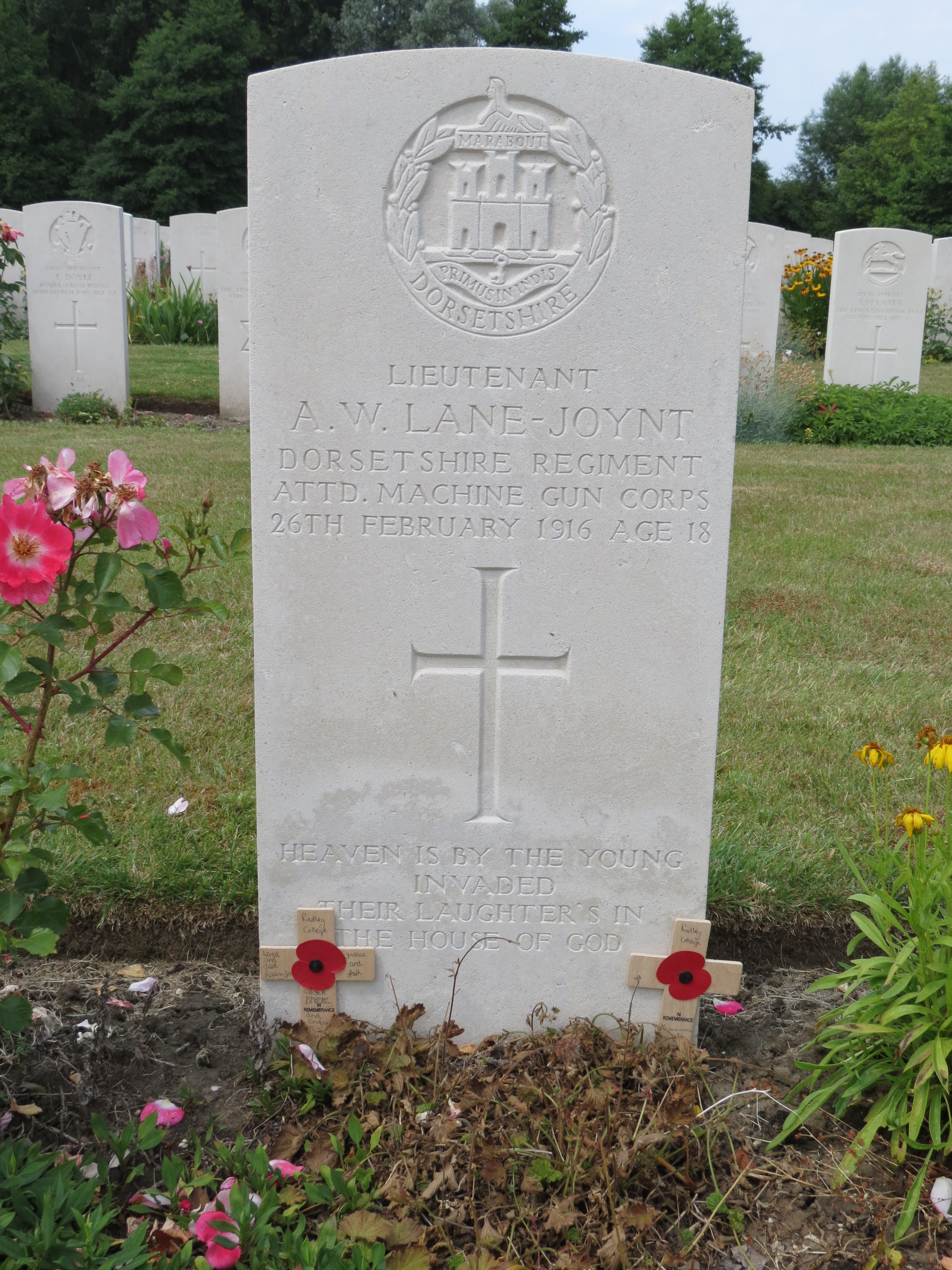
The grave of Albert Lane-Joynt, Guards Cemetery. Photographed for ‘Marching in Memory’ for Combat Stress, July 2015
| 26th February 1916. Albert Lane-Joynt, B Social 1909. Lt, Machine Gun Corps. Killed by a sniper in France. Albert Lane-Joynt played for the Cricket XI in 1913, and joined Surrey CC after leaving school. He is commemorated on the War Memorial at Kennington Oval. He was a cricket aficionado who wrote magazine articles, and immediately on leaving school produced his first issue of the Public Schools Cricket Year Book.
A history of Radley cricket, by AW Lane-Joynt, 1914: … ‘the three best cricket Xl’s turned out by Radley were those of 1867, 1888, and 1913. … The 1913 side had the estimable advantage of a really good captain in O. A. Reid. He was a fine hard-hitting consistent bat and scored 101 (not out) in 80 minutes against Bradfield. His wicket-keeping was better than ever and when he bowled he was certainly the best bowler on the side. Both he and R. C. Keller had averages of 40; with the latter he bore the brunt of the season’s work. Keller is a really fine player with a beautiful cut, and should be heard of in the future. Reid was asked to play in the Public Schools Trial match at Lords… and was eventually chosen as first change bowler for the Public Schools XI. Expert opinion unanimously placed our team high among the school sides of 1913, and there could be no more fitting place to end this brief resume of Radley Cricket.’ [OA Reid won the VC in Mesopotamia in 1917. He died at Johannesburg in 1920. RC Keller served in France 1915-1917, was seconded to the Royal Flying Corps, was shot down and ended WW1 as a POW. ]
Aged 20 |

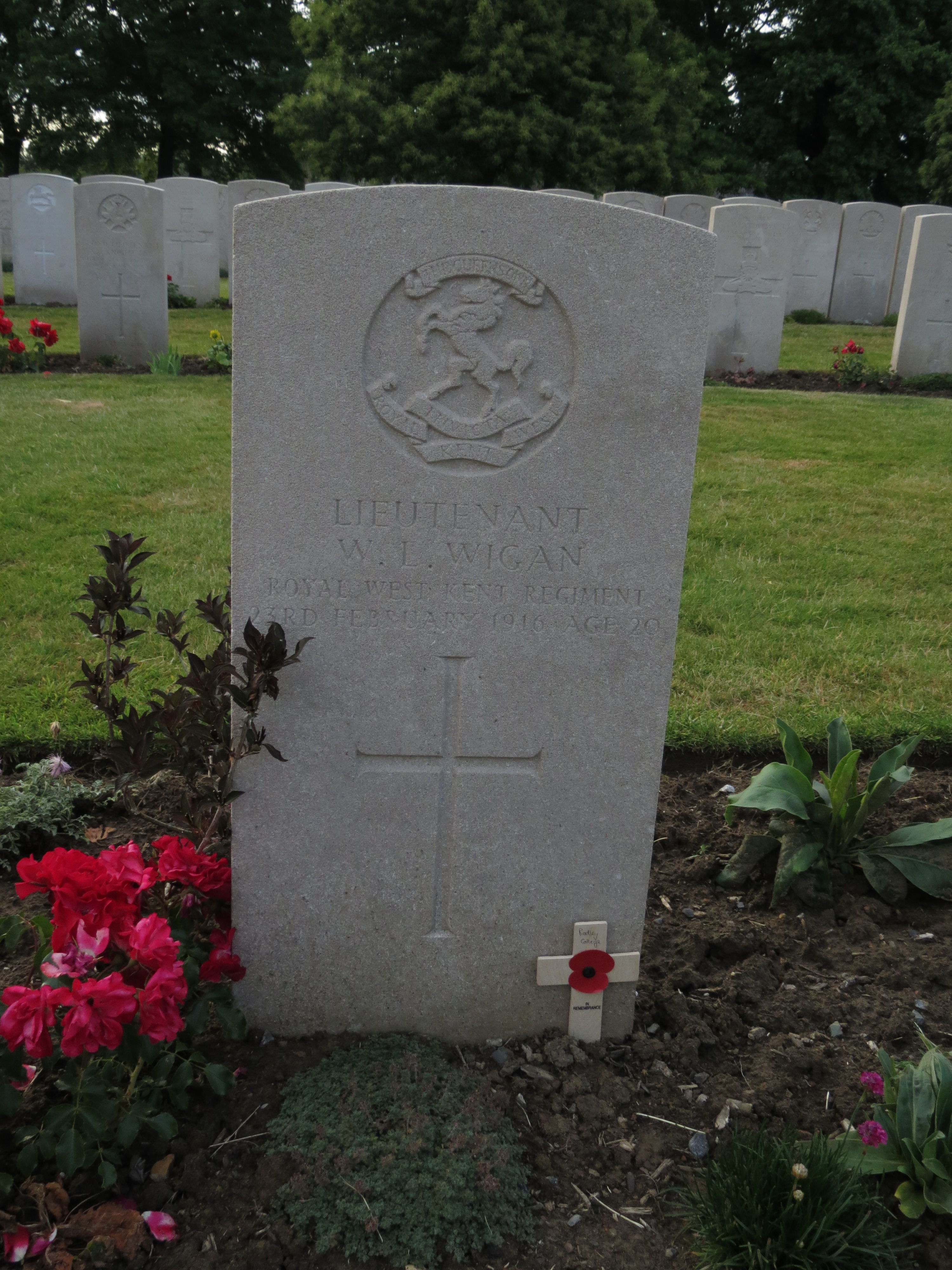
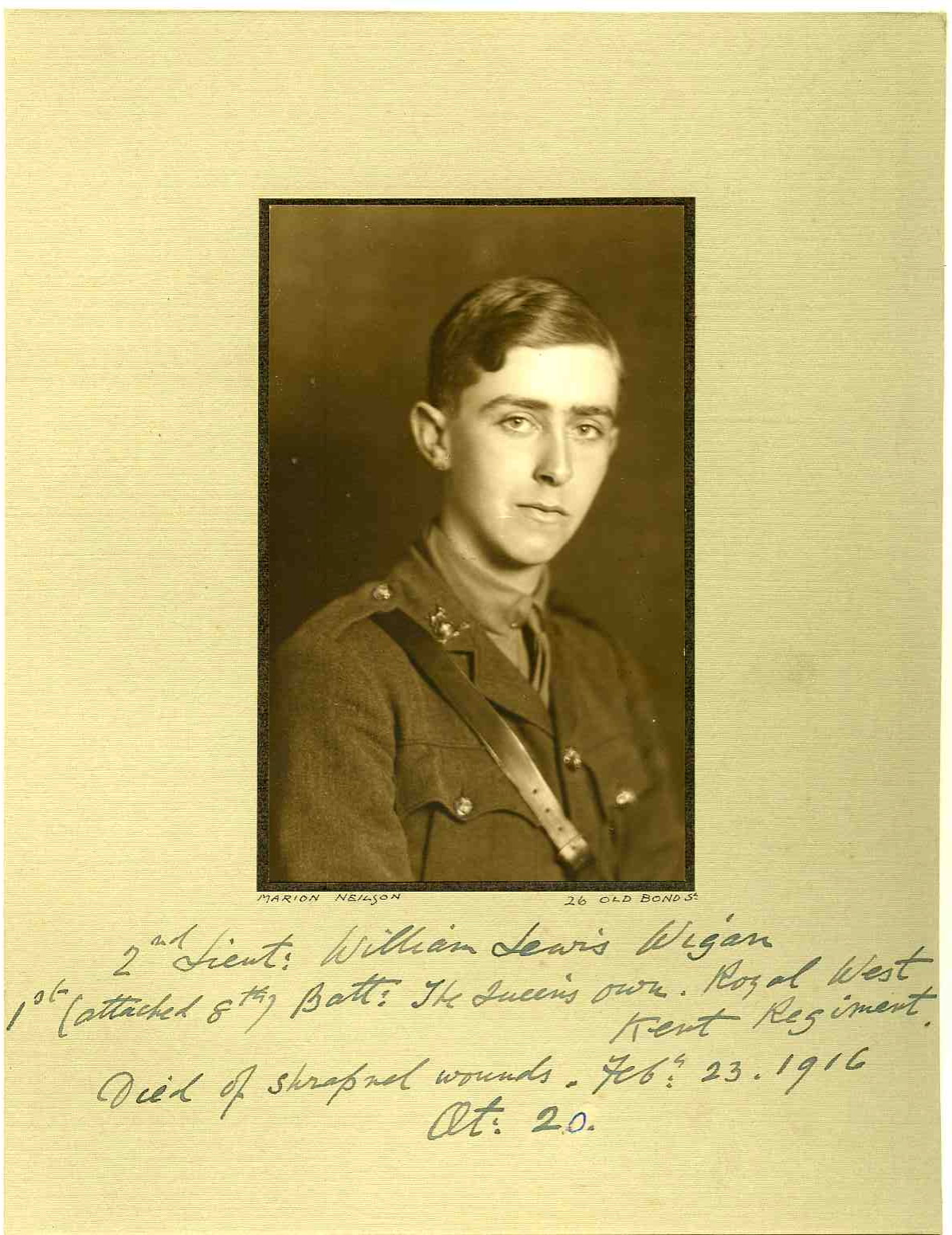
The grave of William Wigan at Lijssenthoek. Photographed for ‘Marching in Memory’ for Combat Stress, July 2015
| 23rd February 1916. William Wigan, E Social 1909. Lt, Royal West Kent Regt. Died of shrapnel wounds near Ypres. He went to Sandhurst in September 1914.
‘ …. He was in a dug-out two and a half miles behind the firing line, with his Captain and two other subs., when a shell dropped in Battalion Commander’s Headquarters some six yards behind them. The Captain who was nearest the door went out to see what had happened and the other three must have started to follow him when another shell dropped right in the doorway wounding all three. The Captain writes: ‘I went to the dug-out to see what I could do, but your son, who looked very pale. though quite calm, waved me away, saying: “Get away, you are the only one left in the Company.” I then sent for stretcher-bearers and doctor: your son then asked for a cigarette which I gave him and lit it for him. The stretcher-bearers, four in number, then went to him, but he said, ‘Look to the others who are worse first, I shall be all right, I have got one leg broken, and am hit through the other.’ …. As I walked with him he said, ‘ Don’t look so worried about me, I shall be all right; shall see you at home.’ I then had to leave him to take my men to the trenches. As I said good-bye to him he blew me a kiss and wished me good luck… I cannot tell you how much we valued and loved him, what a good hard-working officer he was… He was beloved of all the men of the Company, who realised his efforts for them. and what a good hard-working officer he was. . . always cheery, courageous, and energetic. . . He was taken suddenly worse on the morning of the 23rd, became unconscious about 2 pm and died about 4 pm.’
Aged 20 |

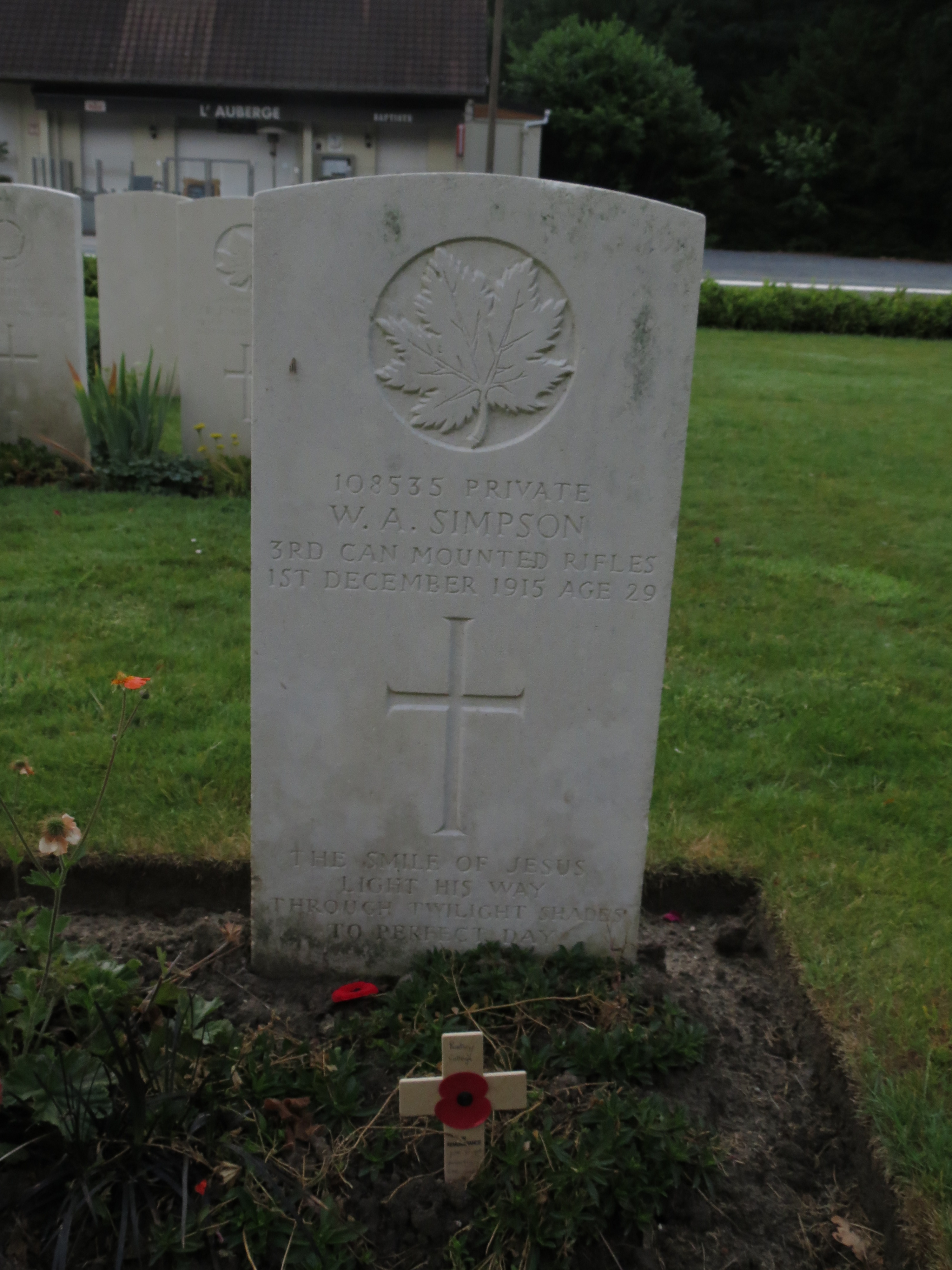
The grave of Walter Simpson at Berks Cemetery. Photographed for ‘Marching in Memory’ for Combat Stress, July 2015
| 1st December 1915. Walter Simpson, D Social 1900. Trooper, 3rd Canadian Mounted Rifles, Canadian Expeditionary Force. Killed in action in an unknown engagement in Flanders.
He was a good oarsman who rowed for Cambridge University Trial VIII in 1906, and won the Ladies Plate at Henley in 1907.
Aged 29
|

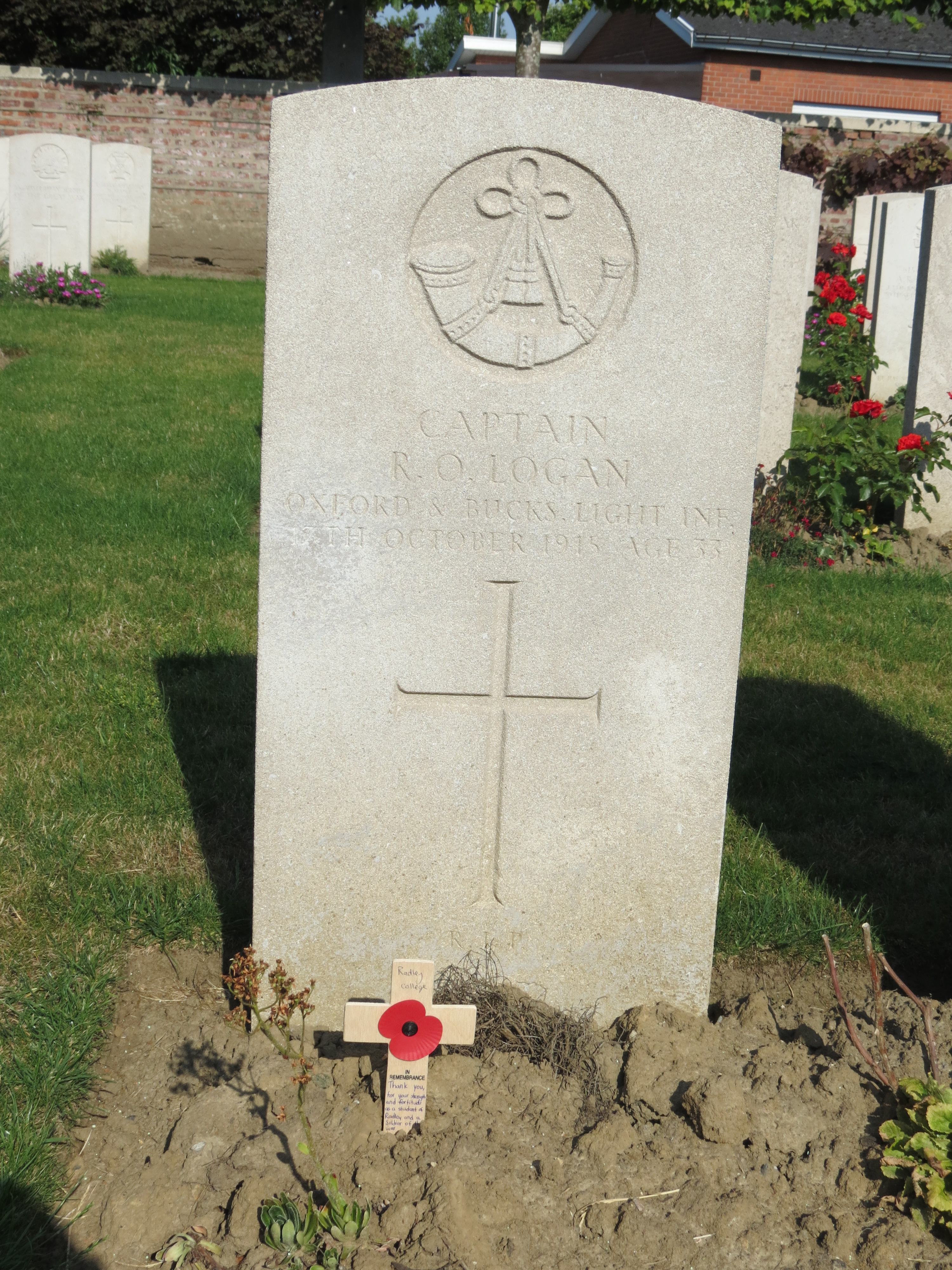
The grave of Roland Logan at Birr Road Cemetery. Photographed for ‘Marching in Memory’ for Combat Stress, July 2015
| 16th October 1915. Roland Logan, E Social 1896. Captain, 5th Bn, Ox & Bucks Light Infantry. Killed in action, Battle of Loos.
He was a career soldier who had served in the Second South African War in 1900. Aged 33 |

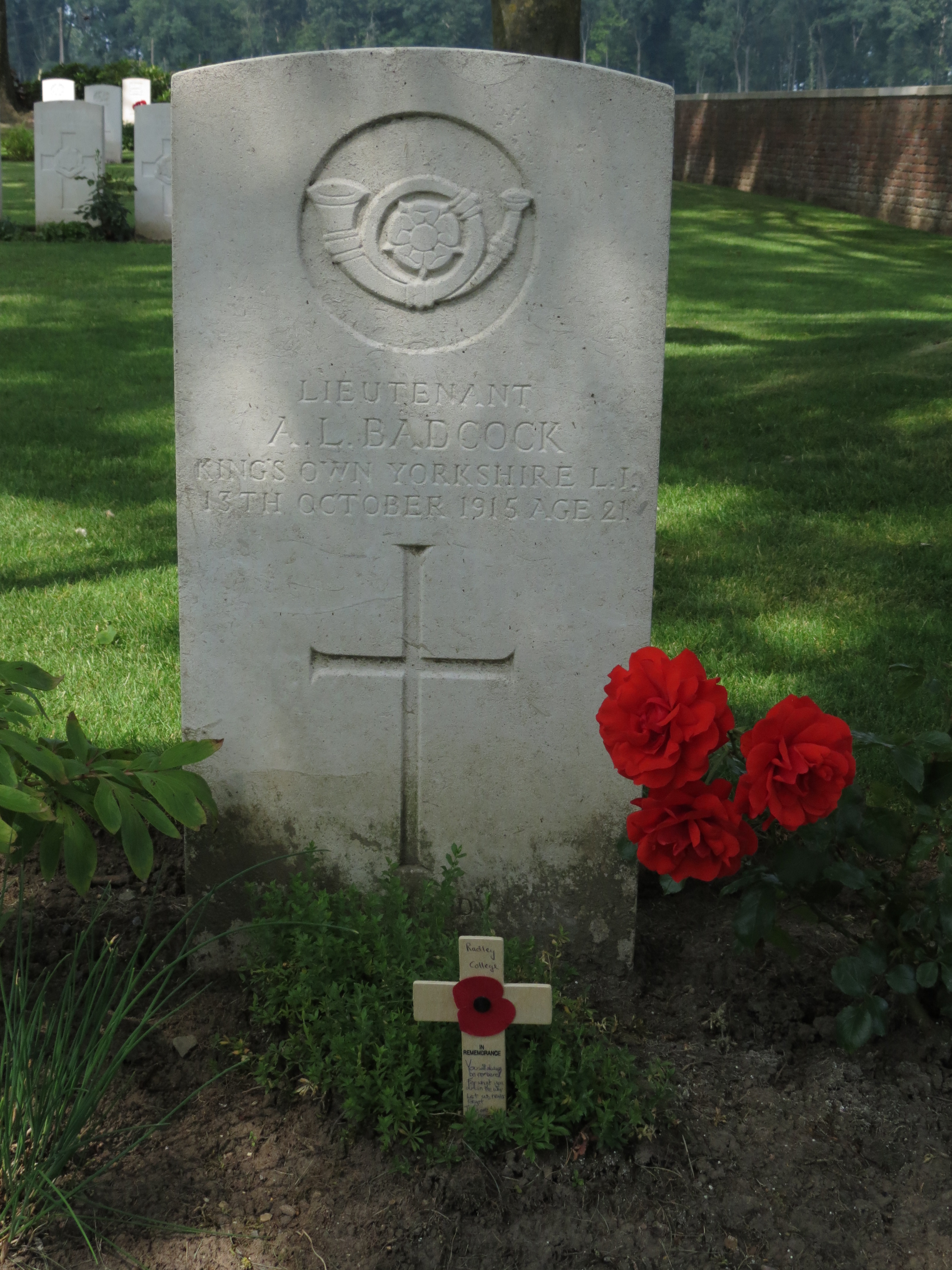
The grave of AL Badcock at Elzenwalle. Photographed for ‘Marching in Memory’ for Combat Stress, July 2015
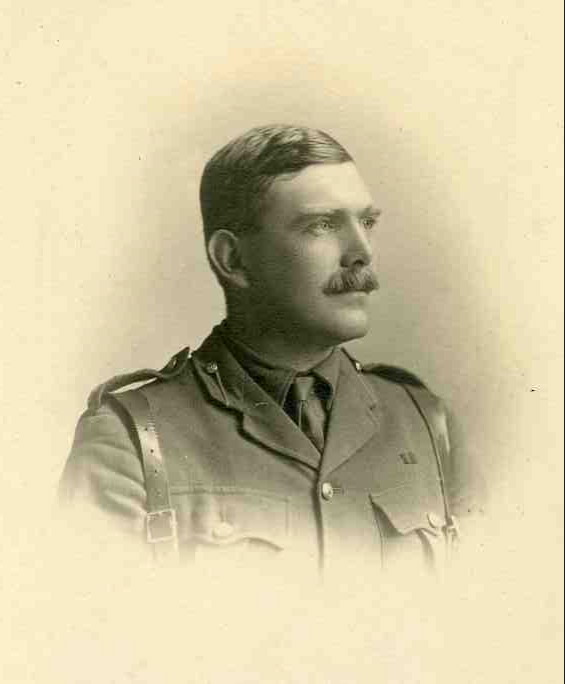
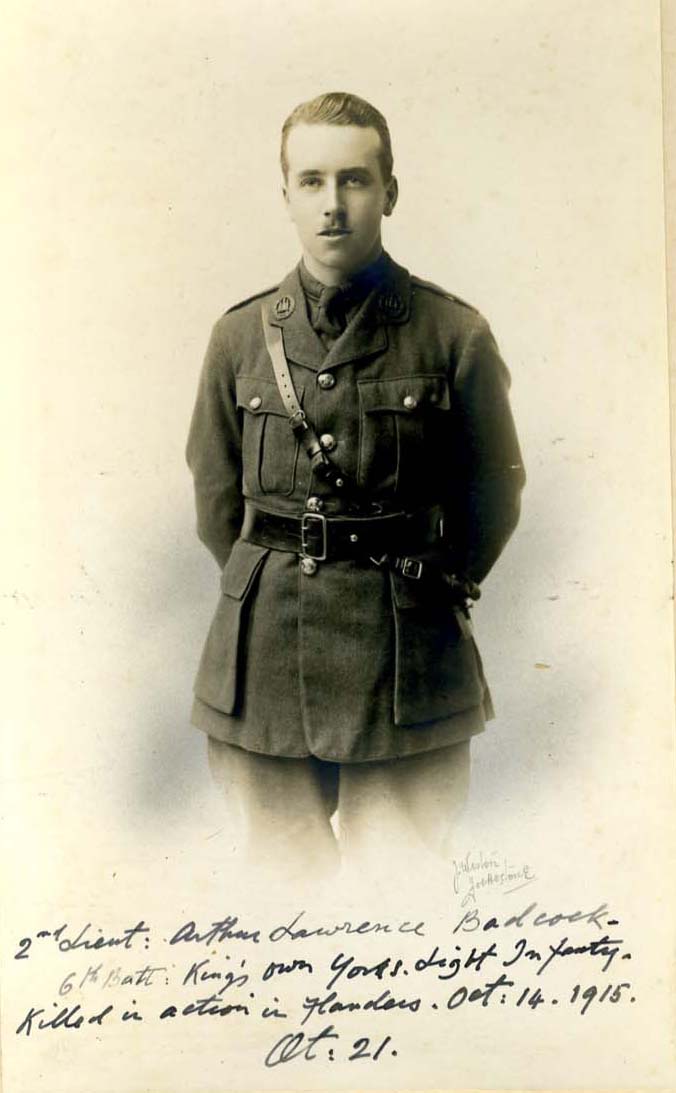
| 14th October 1915. Arthur Badcock, C Social 1908. Lt, 6th Bn, Yorkshire Light Infantry. Killed in action, Battle of Loos.
At the outbreak of the war he was studying medicine at St John’s College, Cambridge. He and his brother, Edmund, volunteered immediately in 1914. Edmund was killed on the Somme in 1916
Aged 21 |

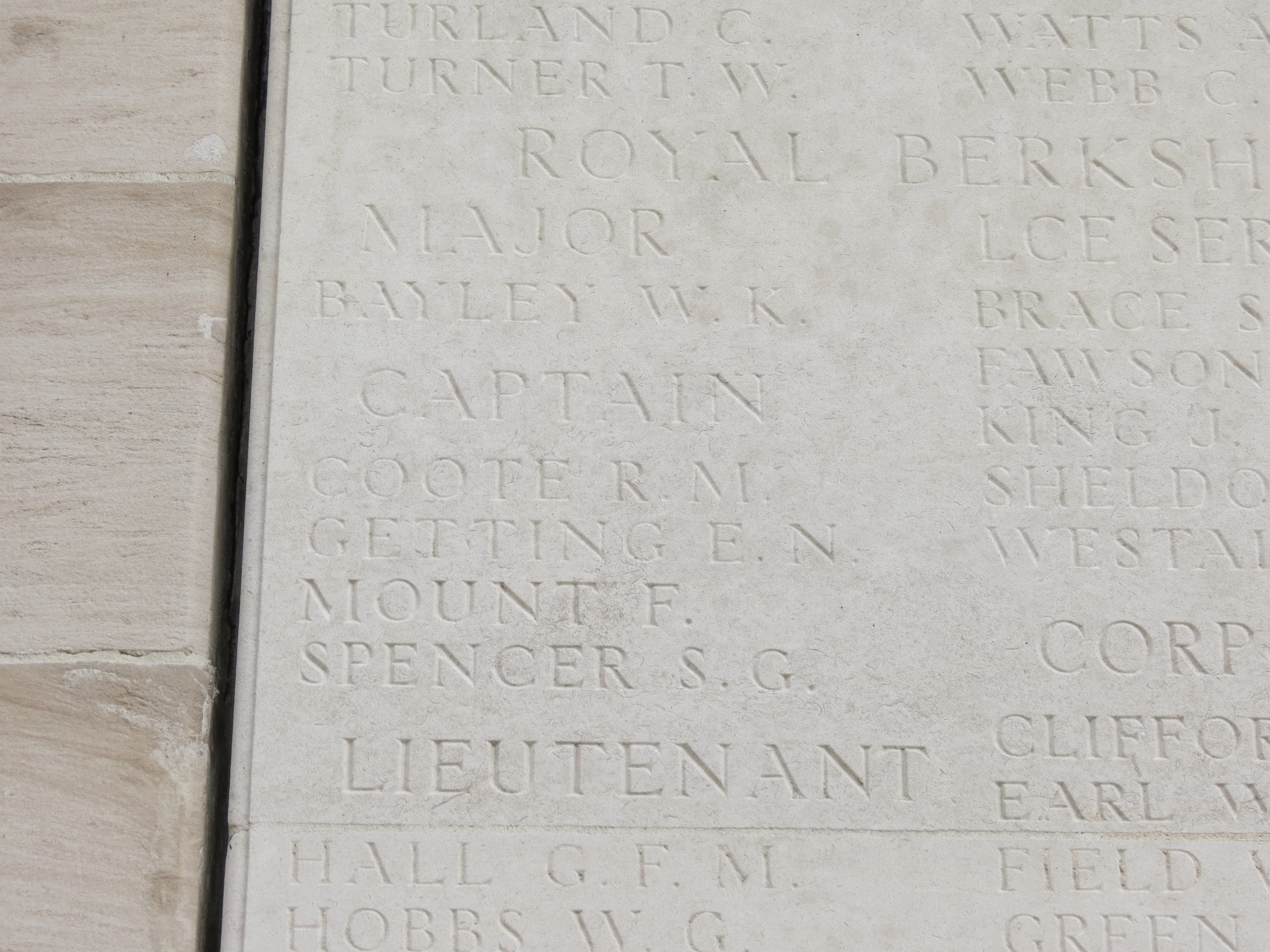
The name of Richard Coote on the Loos Memorial. Photographed for ‘Marching in Memory’ for Combat Stress, July 2015
Today we remember …
| 13th October 1915. Richard Coote, A Social 1906. Captain, 8th Bn, Royal Berkshire Regt. Killed in action at Hulluch, Battle of Loos.
After school he trained as a lawyer at Lincoln’s Inn. Whilst living in London he was a very active supporter of the Radley Mission at St Peter’s, Wapping.
Aged 23. He was one of three brothers who all served in WW1. His brother, George, fell in 1918
|