This account of the earliest days of rowing at Radley College is taken from Walter Woodgate‘s chapter in the 50th anniversary history by T.D. Raikes – ‘A History of St Peter’s College, Radley 1847-1897’
The earliest rowing outing on the River Thames
[1849] The beginning was this – one morning Messrs Savory and Howard chose six boys and me as cox, took us up to Sandford where an eight was lying – I don’t know where she came from. We all got in and rowed her to the new boat house. I never saw that boat manned again that I can remember. Memoir of Philip Gurdon, Radley’s first Rowing Blue (Oxford 1856), who entered the school in 1848.
RECOLLECTIONS OF EARLY RADLEY BOATING, BY W. B. WOODGATE, W. J. HOLLAND, J.B. ORME, W. HOOK, AND OTHERS.
In the autumn of 1850, during the football season, when I (Walter Woodgate) had just arrived at Radley, there were some few of the bigger boys who used to wear what the rest of the School styled “boating hats.” These were of brown straw, trimmed with blue ribbon. There were only some four or five of these straws visible. Tradition, as circulated among lower boys, ran to the effect that Savory and Howard, two of the Fellows, had been in the habit of taking some of the boys to boat at Nuneham in the preceding summer or may be in 1849,- and that the Warden had subsequently stopped these outings. Anyhow a “Radley boathouse” was standing in 1851, and was re-opened for School use in 1852 under Warden Heathcote. The boathouse was never used in ’51, therefore its erection must date prior to ’51. This building stood on the creek on the Berks shore, a little above Nuneham boathouse. The great causeway below the present bridge over this creek was then all bridge, as long as the” Long Bridges” at Oxford.
Again, in Novello’s Part Song-book, at date of 1850, there was a “boating song,” written and composed by Radley authors, and always understood by us boys to have been inspired by Radley boating trips. The song began :-
” The Sun is high in Heaven,
Yet fresh the Zephyrs play;
The river gleams before us,
Why sit we still to-day?”
1851 was a dead blank in Radley rowing. At Easter ’52, Mr. Heathcote revived boating, and instituted bathing. “Passing” was required from this date, before any boy might boat. The length of the pass was about 100 yards (more if the steam runs strong), to be swum in boating clothes. Hounslow became swimming Master.
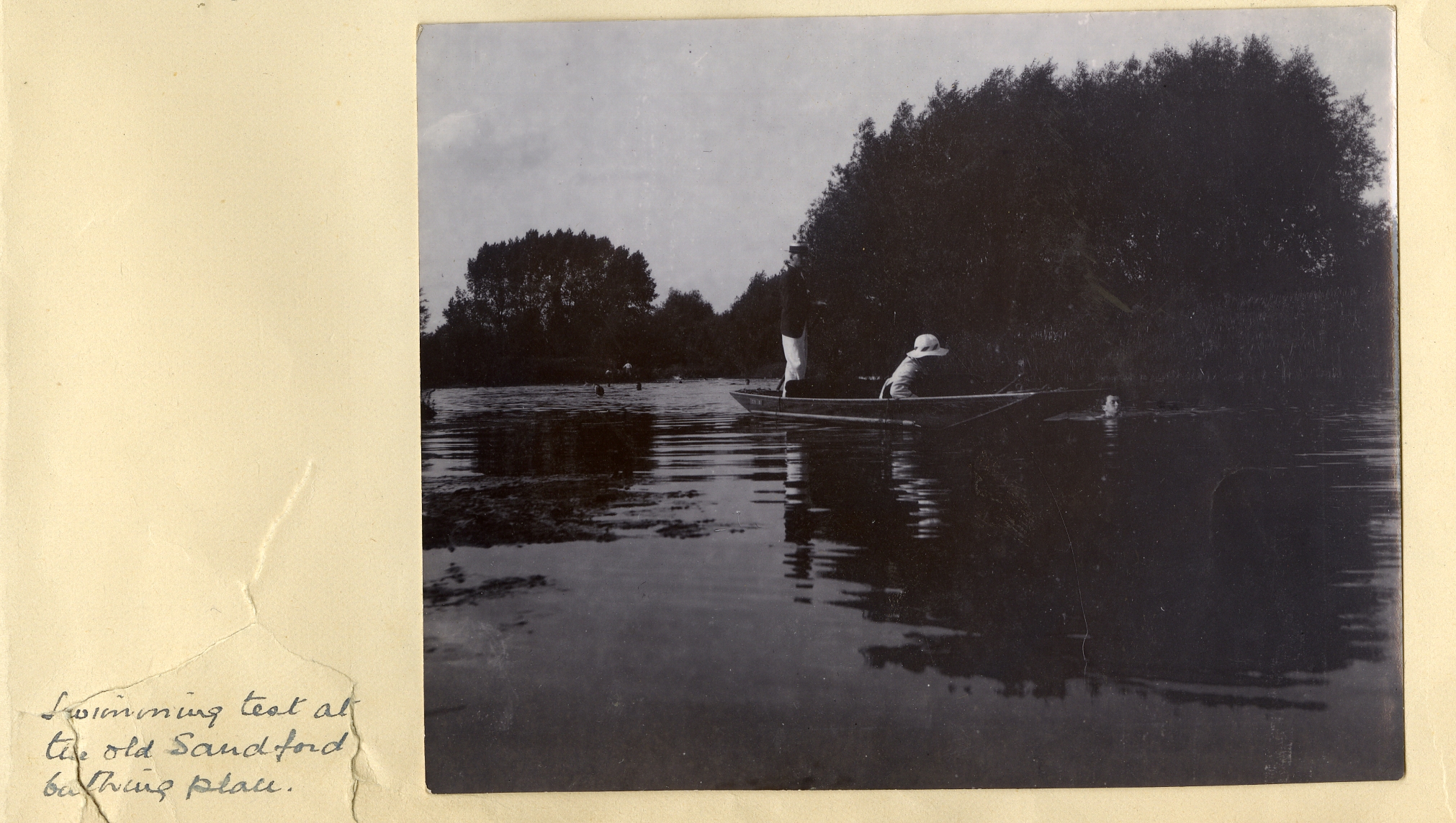
There were two gigs, “Beda” and “Annie,” a tub-four, a sculling wager wherry, inrigged, and a double wherry, green, very heavy, and much slower than either gig. The four was heavy, and soon became unpopular. It was usually manned by some of the smallest boys; the seniors taking the gigs. For a short time there was a so-called racing pair, which only Risley and Austin used (carrying a steerer). She was the” Peri,” canvassed at one end. I think the” Peri ” did not arrive till summer 1853. The usual practice for those who had passed and might boat, was to row from the boathouse to Sandford, bathe, and then row down again. This on half-holidays only; on ordinary days there was not time for more than a brief cruise.
In 1853, Dr. Sewell became Warden, and carried on his predecessor’s system as to boating and bathing. In the summer of 1853, Risley and Austin had a canvassed sculling-boat between them. The “Star” was her name. Austin was leaving in October, ’53’ A four was made up in September, ’53, Austin looking on, as he was leaving so soon, and coaching it. This four was outrigged, and iron keeled. The crew were: – Risley, stroke; R. P. Lightfoot, 3; H.Sewell, 2; Hetling, bow; W. J. Holland, cox. The crew wore the old brown straw-hats with blue ribbon, and white flannel shirts with blue rosettes on the breast. Flannels came in, generally, for all the School, in the spring of ’53. Any boy might then select his own colours.
I “passed” in August, ’53. I remember attempting my first sculling, in the old white wherry, one Wednesday half-holiday in September, 1854. It took me all the afternoon to get up to Sandford and back. The betting was that I should upset! but I just avoided this.
In the summer of 1854, the four broke up again. Lightfoot could not row, or left, I forget which. Risley did not seem to care for it, by himself, with no one else of his size. He had a sculling-boat. In the autumn the four was revived with Janvrin, stroke, Bennett, 3, the others as before. They rowed in the “Undine,” an outrigged gig four, painted black. Other boys lumbered about in gigs, etc., much as before. The wherries vanished. There was another four, in which were J. B. Orme, J. Thynne, F. J. Skinner, and others; J. Dunn steered it. They rowed in the ” Catherine,” of a similar build to the ‘Undine.” Later on the “Undine” crew were promoted to the ” CamiIla,” canvassed at both ends, and the “Catherine ” crew took to the” Undine.”
In 1855 the first Eight began – casually – thus. Boating began on Easter Monday. A first four had been made up -composition doubtful – as the crew only lasted one day. But Risley was stroke, and Holland steered. The ship was the “CamiIla.” Some of the other boys had obtained leave to have an eight down for the day. They got an old ship, canvassed at one end, called the “Rose,” shorter than most of the racing eights of those days, and, I believe, faster than them; but she would only carry about a 10-stone crew, and so was useless at Oxford. This eight was manned by some of the second four of the previous autumn, and some other senior boys, who seldom boated, and were habitually bad oars: one, for instance, joined the crew for the day.
A race between the Eight and the “CamilIa” was arranged – from the railway bridge to Nuneham Island. The Eight won by any distance, to the astonishment of the four! The holidays began two days later; but the episode had the effect of stimulating ambitions for a school Eight, and one was manned in the next term. The first crew of this real Radley Eight of the summer term of 1855 were:- J. B. Orme, bow; H. Sewell, 2; C. P. Austin, 3; B. Monsell, 4; J. C. Thynne, 5; A. Bennett, 6.; F. I. Hetling, 7; R. W. Risley, stroke; W. J. Holland, cox.
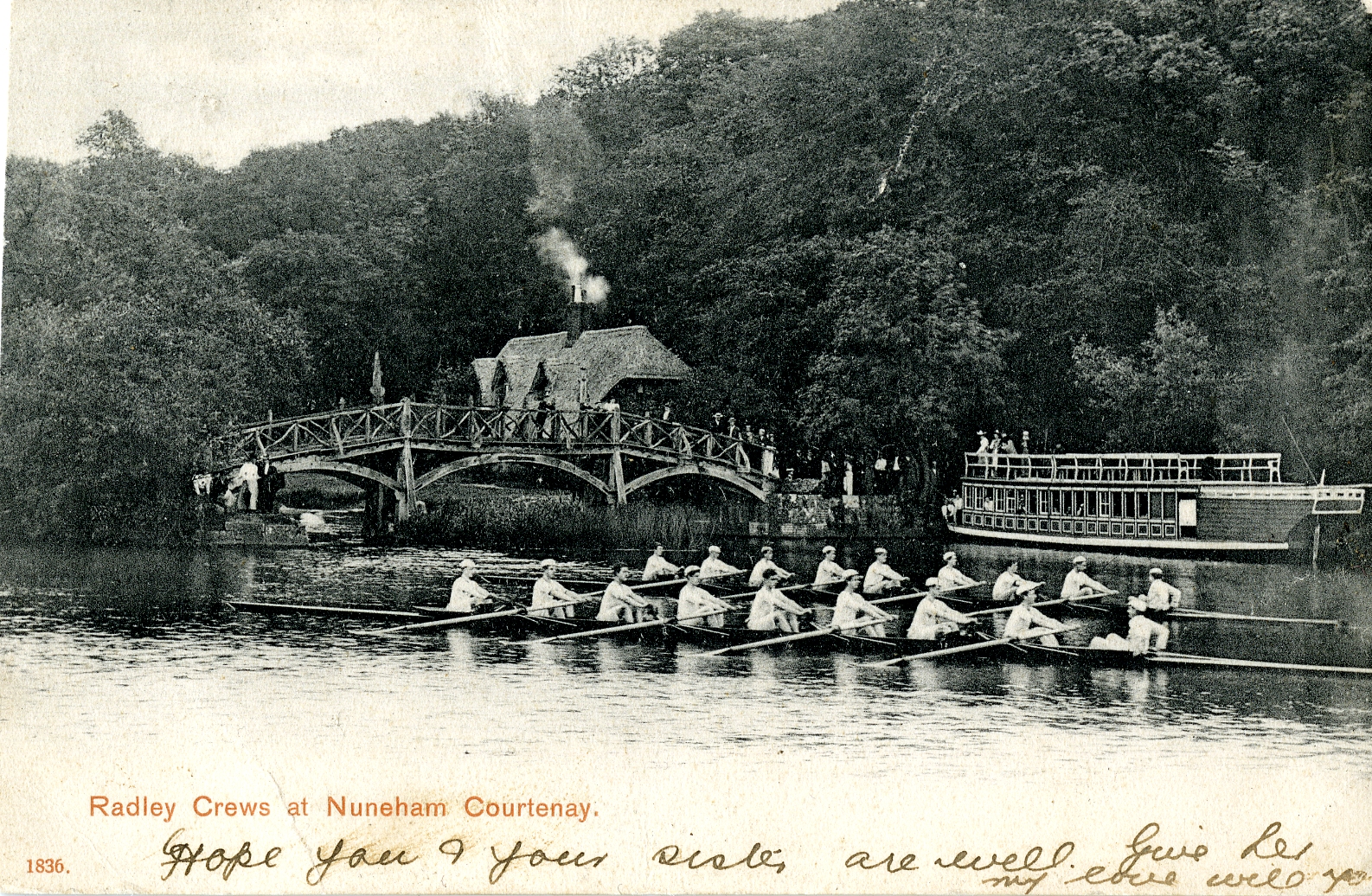
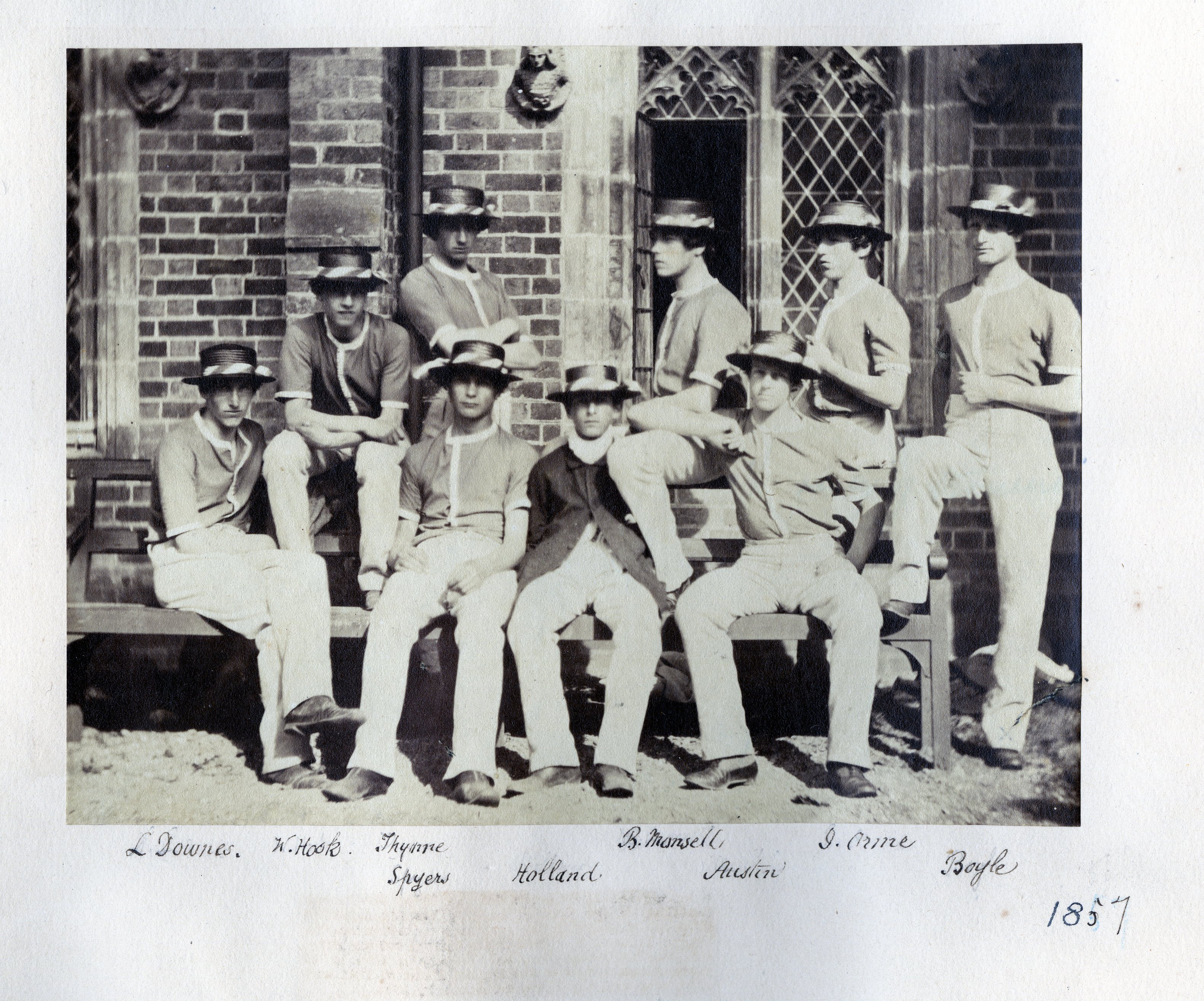
The crew started a uniform. It was a flannel pattern, purveyed by the usual Oxford tailor who had most of the School custom. The costume was a long-sleeved shirt (not jersey). The colour was a brickdust red, with white in parallels about 1/3 of an inch wide, i.e. one stripe of red, then a similar width composed of three lines of white and red; then another full band of red again, and so on. Some time during the season the crew started the now time-honoured red and white twist ribbon; at first on a brown straw hat, later on, perhaps not till ’56 or ’57, on white straw. There were no regulation coats till the spring of ’58. In ’56 the Eight consisted of W. Hook, R. A. Boyle, J. B. Orme, H. W. Irons, J. C. Thynne, B. Monsell, C. P. Austin, H. Sewell, W. J. Holland, in the order named, from bow to cox.
J. B. Orme remembers: – “In 1855 and 1856, we used to practise saluting to a considerable extent; so expert did we become at it, that we could all stand up together, and hold up our oars. This performance used to please the Warden, when he brought ladies down to see the crew. On Whit-Tuesday we generally used to row to Clifton Hampden and have lunch. I recollect spurting the whole way home, from lock to lock, back to Sandford, to get in time for Chapel – Risley at stroke.”
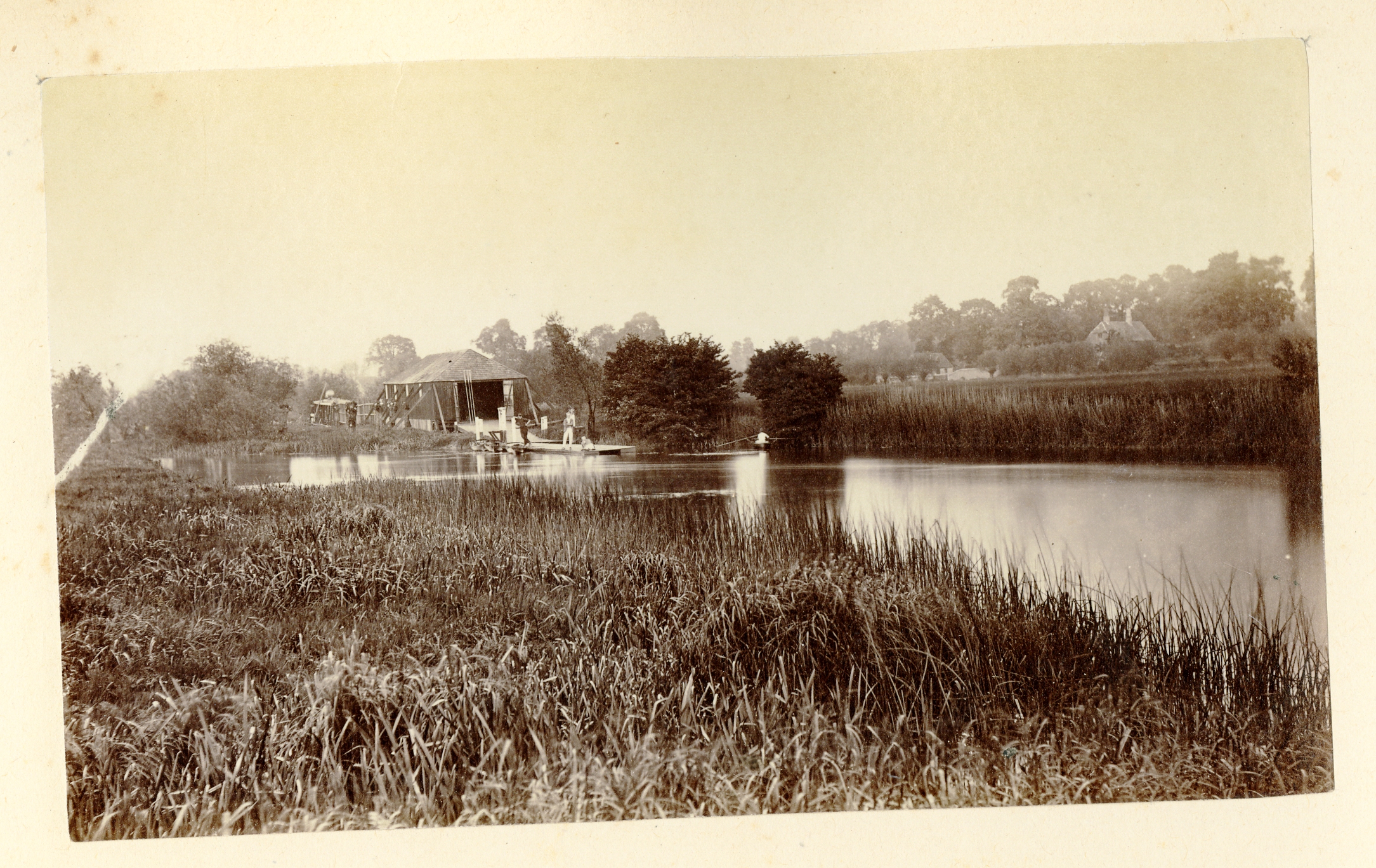
By tthe summer of 1856 the locations for the boats had been transferred from the old boathouse in Lower Radley, to Sandford. Only a raft was provided at Sandford, just above the bridge. From this time to the summer of ’58 the lock-keeper looked after the boats, and housed oars, cushions, etc.
In ’57 pairs were instituted. Silver oars and rudder for first crew, and three silver anchors for the second (challenge), were given by Lord Forbes, then a Fellow of the College; no two of the First Eight were to row ‘together. The winners were, first, B. Monsell and L. Downes, Holland cox; second, R. Boyle and H. A. Spyers (a dry-bob), with T. F. Skinner, cox. The winners rowed in the “Peri.” All sorts of build of boats were used from outrigged gigs to canvassed pairs, and all had coxswains. The” Peri” was canvassed at one end.
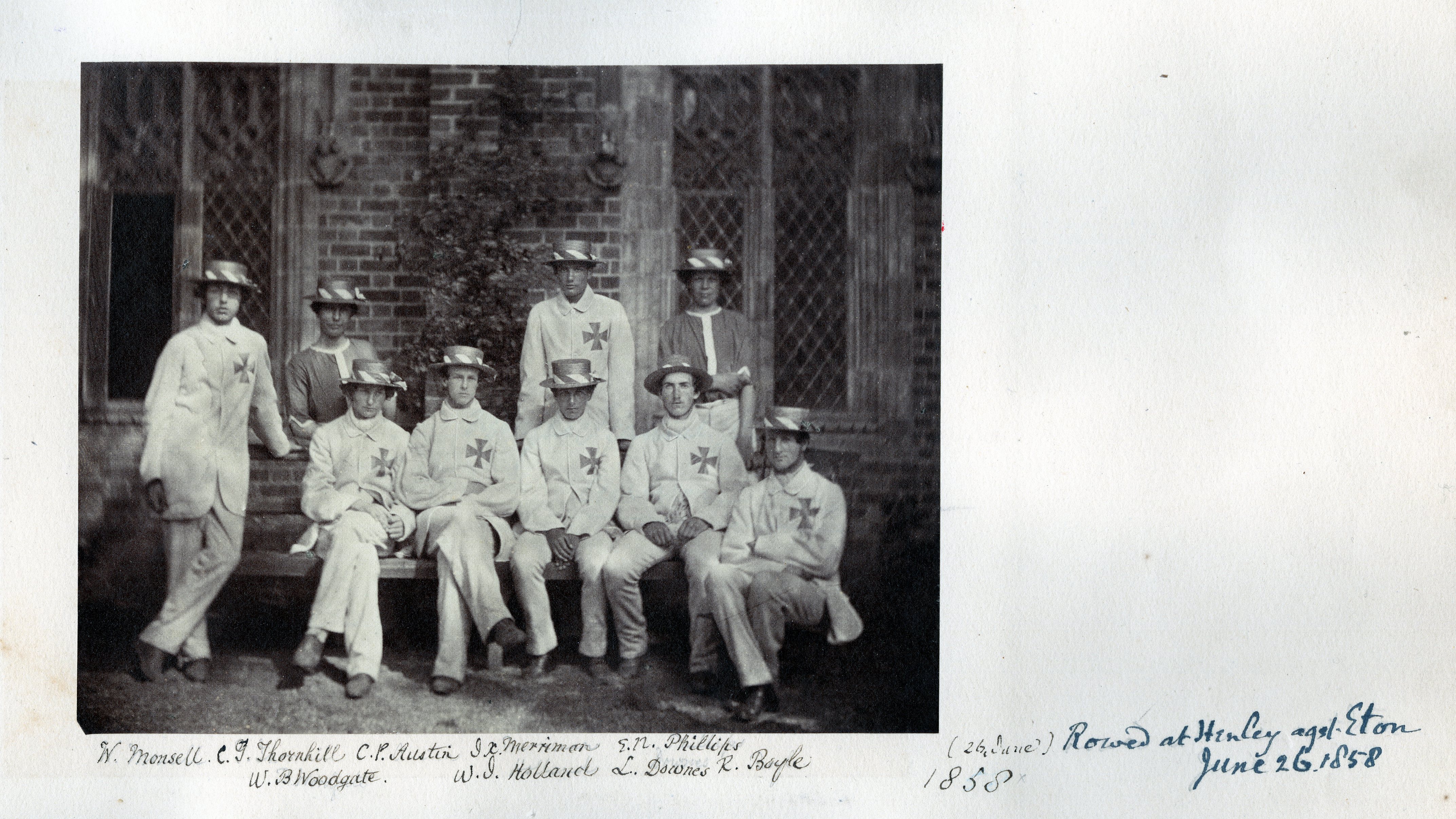
In the spring of ’58 a match between Eton and Radley was mooted, and eventually arranged, E. Warre and R. W. Risley, for Eton and Radley respectively, having most to do with preliminary negotiations. The Hon. V. Lawless, now Lord Cloncurry, was then Captain of Eton. He came to Radley one day to see the Radley Captain and crew. The match was arranged to come off after the Henley Regatta, a day or two later, over the Henley course. Coats, as now worn, white, with Maltese Cross in crimson, were designed for this race; also “jerseys” made of coarse flannel, short, sleeved, and trimmed white. Efforts were made to get woven cerise jerseys; but no manufacturers could produce lambswool to hold the dye. The hat worn was the same as now. There was no First Eight cap.
During practice Risley and Austin coached,- mostly Austin; Risley having his Exeter crew on hand for the Ladies’ Plate. Exeter gave Radley two trials up Long Reach to Sandford,- a bumping-race, with one length start in each case. The first time Radley got home safe. The next time they caught crabs in the weeds at the start and were bumped in less than a minute.
The race with Eton was started and umpired by Risley. Eton chose Bucks Station. The wind was a stiff” Bushes” breeze. Eton led all the way. Radley came up fast round Poplar Point, and were beaten by about two-thirds or three-quarters of a length. Large numbers of boys of each School were present as spectators. Only three old choices were left for this ’58 crew, Austin, Downes, and Boyle. The other five names are new.
The following are the names and weights of the crews who represented Eton and Radley on this interesting occasion ;-
ETON COLLEGE: bow C. H. Hall; 2. V. B. Van de Weyer; 3. D. Ricardo; 4. C. Wynne; 5. E. W. Hussey; 6. Hon. F. C. Trench; 7. H. CoIlings; str. Hon. V. F. Lawless; cox. F. Hopwood
RADLEY COLLEGE: bow W. T. Monsell 9st 2lb; 2. W. B. Woodgate 9st 5lb; 3. G. J. Thornhill 9st 0; 4. R. A. Boyle 10st 5lb; 5 J. X. Merriman 10st 8lb; 6. E. N. Phillips 10st 3lb; 7. L. Downes 11st 0; str. C. P. Austin 11st 0; cox. W. J. Holland 8st 0
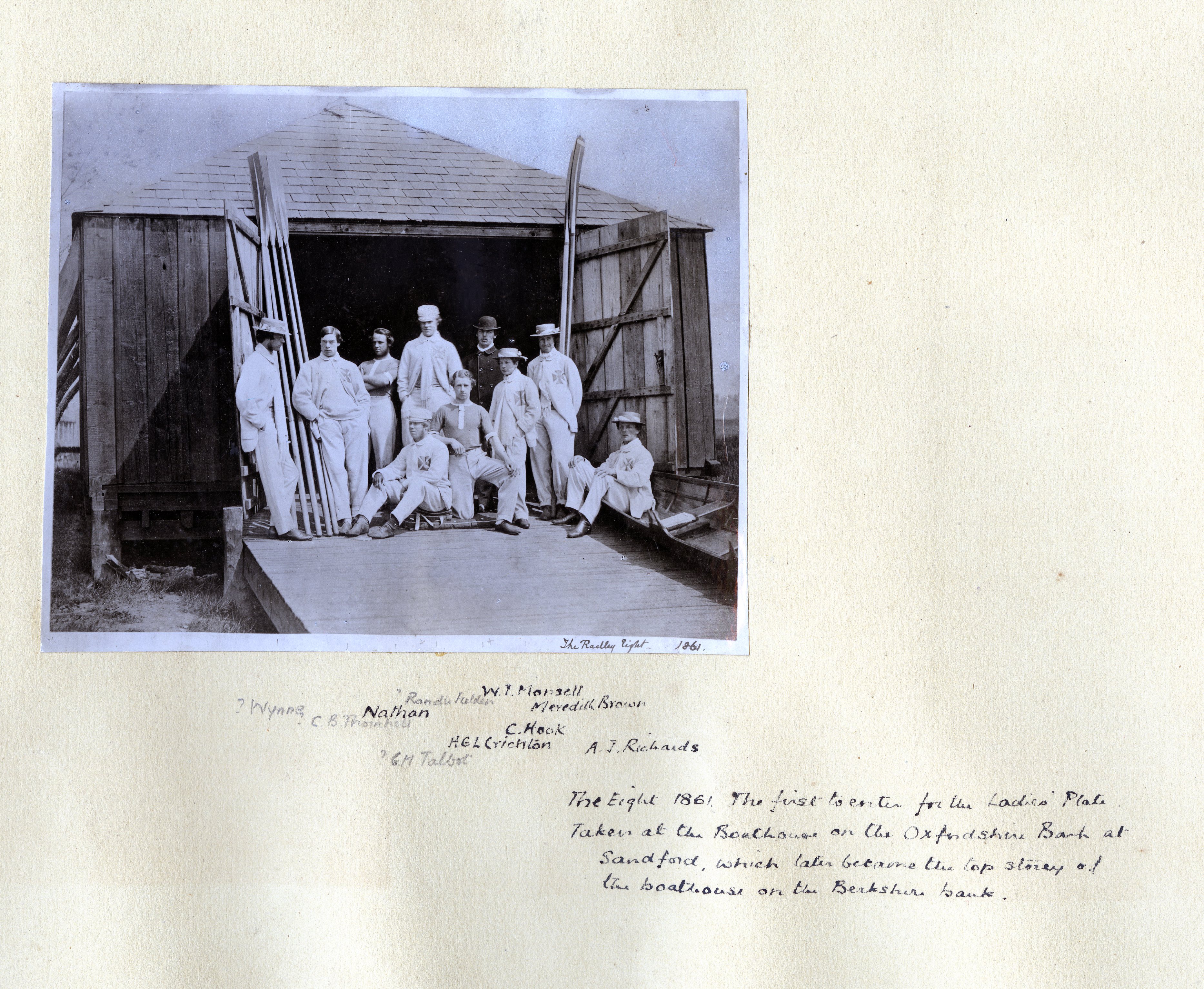
Walter Woodgate left Radley in 1859 to go up to Brasenose College, Oxford. There was no Eton race. Radley challenged, and were refused by Blake-Humfrey, Captain of Eton, who volunteered in his letter that Eton did not intend to row any more such matches with Radley. In 1861 the two Schools simultaneously made their first entry for the Ladies’ Plate at Henley Regatta. Radley’s rowing story was then taken up by H.M.Evans, followed by Vyvyan Hope.
Clare Sargent 2026
<<<More about rowing at Radley>>> Boathouses
<<<Read on>>> 1938 The Ladies’ Challenge Plate at Henley
<<<Read on>>> Inter-Social Rowing
<<<Read on>>> Radley College v Tabor Academy, USA, 1938

